The Days of Treating Preventative Maintenance As Optional Are Dead
Why does preventative maintenance matter more right now?
It reduces the cost of breakdowns. A breakdown on the road costs more than the same repair in a shop. Technicians charge $149 per hour on average for roadside repairs versus $139 in-shop, according to Fullbay. Regular PM lets you catch and correct issues on your timeline — not the road’s.It keeps you running safer. Brake and tire failures are the most common vehicle-related factors in fatal large truck crashes, according to FMCSA. A consistent PM checklist focused on those systems reduces the risk of a mechanical failure becoming something worse.It protects your uptime. The average fleet truck breaks down every 10,000 miles. Top-performing fleets with strong maintenance programs see breakdowns every 75,528 miles. A truck that stays in service is a profitable truck. A truck sitting at a shop is not.It protects your CSA score. Consistent PM is the best defense in a DOT inspection — scheduled or surprise. A failed inspection harms your CSA score, your reputation with shippers, and in the worst case, puts you out of service.It improves fuel economy. Low tire pressure, dirty air filters, misalignment, dragging brakes — each of these hurts MPG. Fuel accounts for 20%–40% of fleet operating costs. A half-mile-per-gallon improvement on 100,000 annual miles adds up fast.It extends your truck’s life. New truck prices increased 12% from 2020–2025, according to Transport Topics, and financing rates for owner-operators with good credit average 5%–12%. Protecting that investment through regular maintenance is one of the highest-return decisions you can make.It lowers your insurance exposure. Underwriters check your inspection record. A rigorous PM program — and the maintenance logs to back it up — can work in your favor when premiums are being set.It controls costs before they compound.According to ATRI, the costs of trucking have never been higher. Catching a minor issue through PM and fixing it on your schedule is cheaper than the same repair as an emergency — plus towing, a rental truck, a hotel, and lost loads.It builds your reputation. Shippers need partners whose equipment won’t go down mid-delivery. A consistent PM record is a selling point that supports on-time performance and safety.What does preventative maintenance include today?
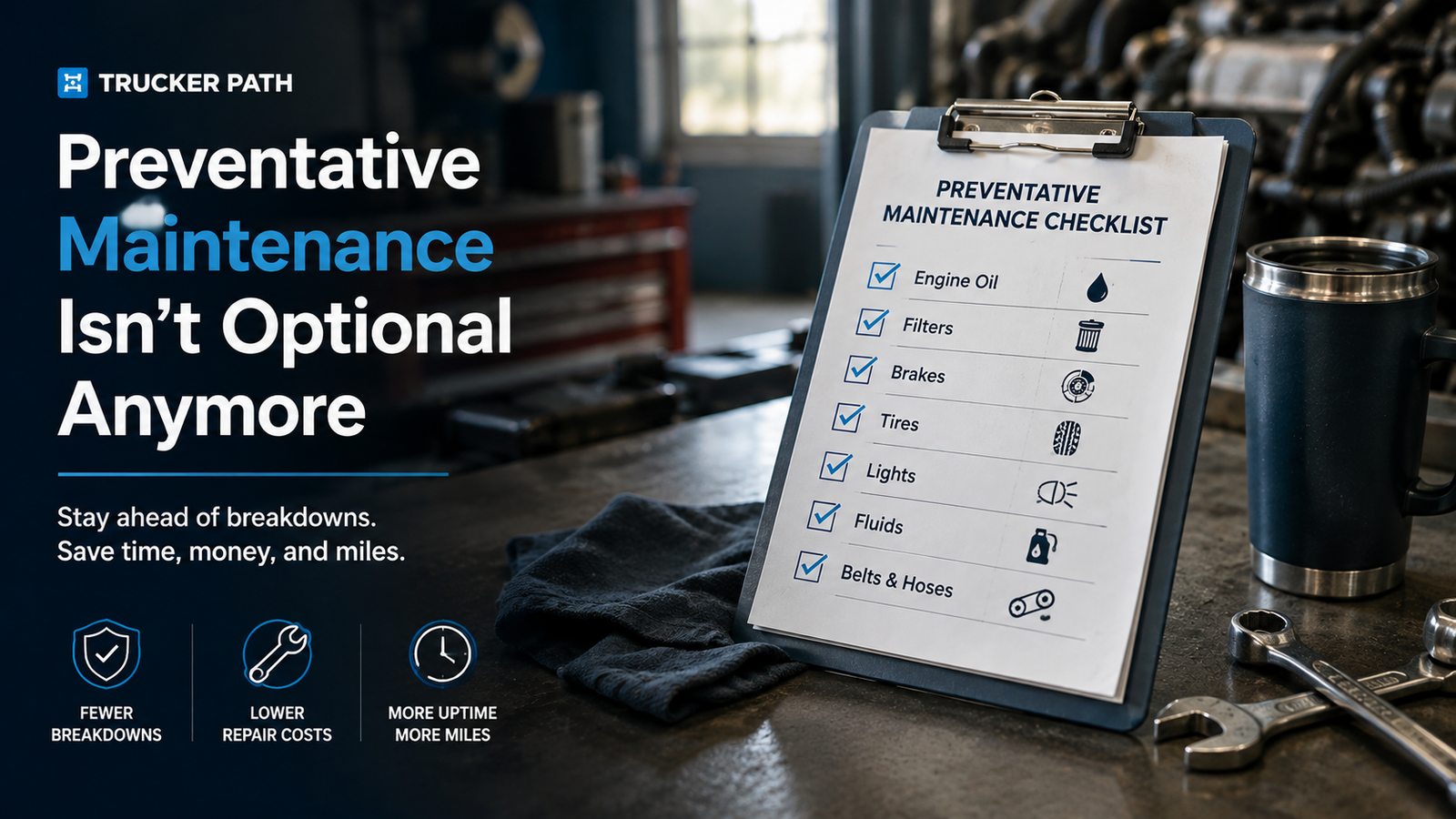
PM is a comprehensive, ongoing effort to keep your equipment in good working order and catch problems before they become failures. A complete program covers:- Performing preventative services — adding fluids, changing filters
- Flagging worn items for replacement before they fail
- Proactive fixes — seepage, rubbing wires, air leaks — before they become major repairs
- Inspecting trailer condition: brakes, tires, frame, and floor
- Checking securement gear, especially for flatbed operations
What should a daily, weekly, and monthly PM plan look like?
Daily- Check oil, coolant, and other fluid levels
- Peek under truck and trailer for wet spots
- Drain air tanks
- Inspect tire treads, sidewalls, and pressure
- Test headlights, turn signals, and marker lights
- Check tractor and trailer tire pressure with a gauge
- Inspect belts for cracks or wear; hoses for bulges or leaks
- Look for rubbing air lines and wiring under the truck and address them
- Check batteries and cables for corrosion and looseness
- Clean windshield sensors and cameras if applicable
- Check brake lining thickness; inspect drums and rotors
- Check suspension: bushings, airbags, and hangers
- Look for alignment issues: uneven tread wear, off-center steering, pulling to one side
- Review DPF regen history
- Check your inspection, repair, and maintenance record for recurring issues
How does a consistent PM habit pay off over time?
The value of a PM program is consistency. When you follow a schedule, there’s no question of whether you did it and no risk of putting something off. With a repeatable process, new issues stand out and don’t get missed. Good PM is good business. It maximizes your use of equipment, minimizes costs, and creates a reliable operation — which matters more, not less, as this market gets tighter.Frequently Asked Questions
Why is preventative maintenance more important now than it used to be?
The average age of heavy trucks on U.S. roads hit 6.3 years — the highest in decades. Older equipment requires more attention to stay road-ready, and the cost of a breakdown has never been higher. At the same time, ATRI reports that trucking operational costs are at record highs, making cost control through PM more critical than ever.What are the most important things to check every day?
Fluid levels, air tanks, tires (tread, sidewalls, and pressure), and lights. These take a short time and catch the issues most likely to cause a breakdown or fail a roadside inspection.How does PM affect CSA scores and insurance?
DOT inspectors check the same systems you check in a PM routine — brakes, tires, lights, and securement. A consistent PM program reduces the chance of a violation that hurts your CSA score. Insurance underwriters also consider your inspection record and may ask for maintenance logs when setting premiums.How does PM connect to fuel costs?
Underinflated tires, dirty air filters, dragging brakes, and misalignment all reduce fuel efficiency. Fuel makes up 20%–40% of fleet operating costs. Keeping those systems in spec through regular PM is one of the lowest-cost ways to protect your MPG.What’s the difference between a breakdown every 10,000 miles and every 75,000 miles?
That gap — documented by FleetOwner between average fleets and top-performing fleets — comes down almost entirely to maintenance discipline. At 100,000 miles a year, that’s the difference between roughly 10 roadside breakdowns and one. Each roadside breakdown costs more in repair labor, towing, lost loads, and downtime than the same fix would have in a shop.Summary
- The average U.S. heavy truck is now 6.3 years old — the highest in decades — making PM a front-line priority for keeping aging equipment profitable
- Roadside repairs cost more than shop repairs ($149/hr vs. $139/hr), and breakdowns carry additional costs: towing, lost loads, hotels, and rental trucks
- Top-performing fleets break down every 75,528 miles versus the industry average of 10,000 miles — the difference is maintenance discipline
- PM protects CSA scores, lowers insurance exposure, improves fuel economy, and extends truck life — all of which directly affect cost per mile
- A daily, weekly, and monthly PM schedule removes the variables: if you follow a routine, issues don’t get missed and problems don’t grow into expensive repairs
Sources
- Truck News — “Economic trucking trends: Class 8 fleet older than it’s been in a decade”
- Fullbay — State of Heavy Duty Repair 2024–2025
- FMCSA — Large Truck and Bus Crash Facts 2021
- FleetOwner — “Study: Roadside truck breakdowns occur every 10,000 miles”
- FleetOwner — “Data helps keep repair costs down”
- Transport Topics — Class 8 truck pricing
- ATRI — An Analysis of the Operational Costs of Trucking, 2025 Update
- New York State DOT — Tractor Trailer Preventative Maintenance Checklist