The misconceptions you hear from 4-wheelers about truck drivers can be laughable and frankly, absurd. At Trucker Path, we like to refer to these misconceptions of truck drivers as “Tales of an Uninformed 4-Wheeler”. Some are so crazy that all you can do is laugh at them.
Sometimes 4-wheelers just don’t understand what it’s like being a truck driver. Trucking requires learning an all new set of laws, regulations and the skill to drive an enormous big rig in some of the tightest spaces. It’s unlike any other career.
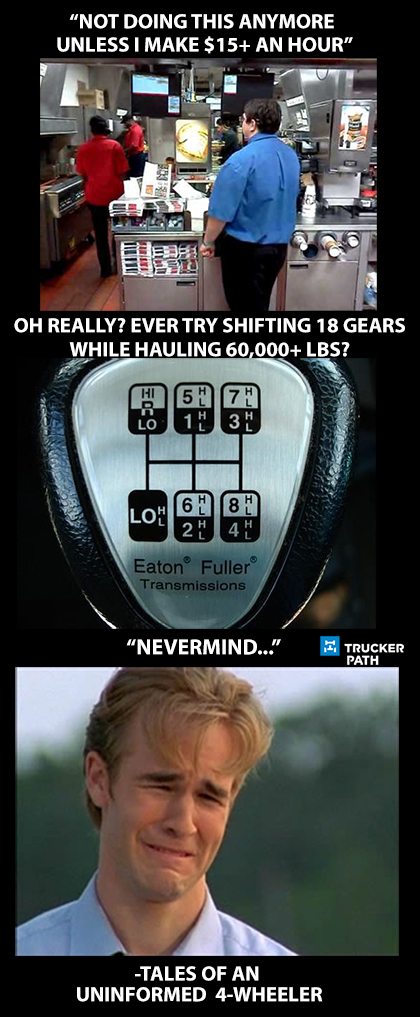
Why do trucks pass each other on the highway?
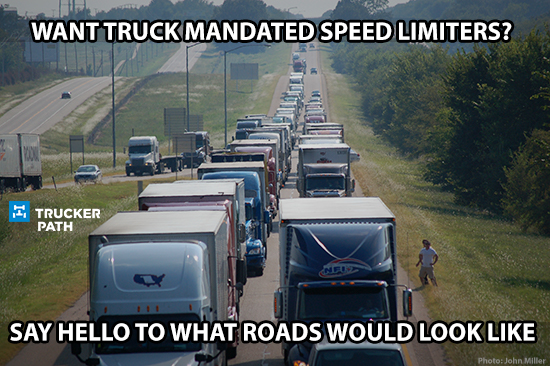
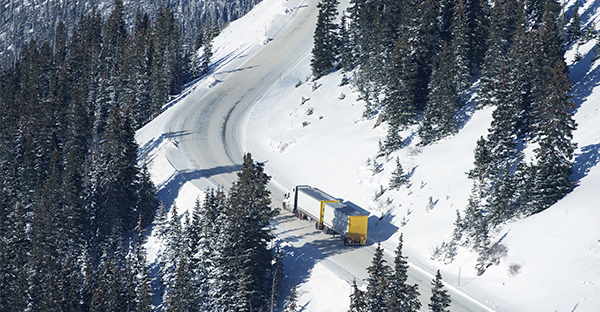
You hear this all the time. A 4-wheeler gets stuck behind a truck for a few seconds while the truck driver passes another big rig. There are several factors that play into this. It’s partly because some trucks are governed at a certain speed (some 60 mph) and some are governed at a higher mph or not at all. Also, some trucks carry much heavier loads than others. An incline in the road can also factor into this occurrence as some trucks hauling cargo uphill struggle to even go 50 mph. Due to this, some truck drivers have no choice but to pass a slower or heavier truck but at times, can only go a certain speed to pass.
Now the Department of Transportation has proposed a speed limiter for all commercial trucks weighing over 26,000 pounds. If the proposed truck speed limiters mandate passes, you will see a dramatic increase in this “inconvenient truck passing”.
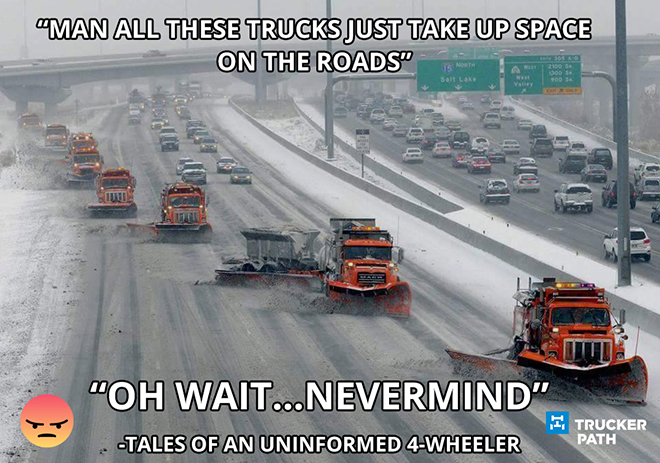
Then there are some 4-wheelers who think trucks are an inconvenience on the road altogether. Not only do truck drivers deliver 80 percent of all cargo in America, but they are used for disaster relief and various other tasks to make life easier for 4-wheelers.
Or the ones who think driving a truck is a simple job because all truck drivers have to do is sit in a chair.

Did we forget to mention that driving a truck is the deadliest job in America. In 2015, there were 745 truck driver fatalities, more than any other.
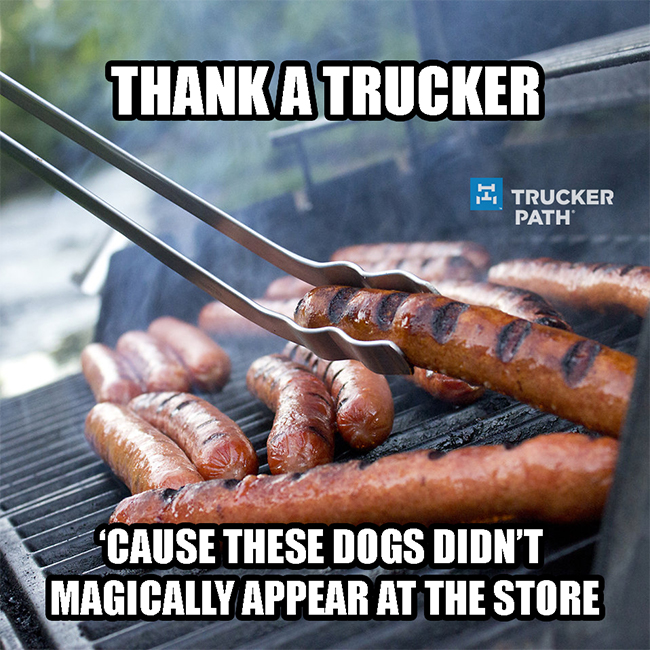
It’s time we debunk the myths about truck drivers. Don’t like trucks? Better rethink that one. Without truck drivers, shelves would be full of dust within a few days.




How to start your own trucking company [p]If you're looking through articles on how to start a trucking company, chances are that you want to work for yourself. If you have been a trucker for a while and looking to get off the road whilst still staying in the industry, then it's a good idea to start your own business. You can hire drivers, buy trucks and start earning more money! In this article, we will take you through some of the key things to consider when starting your own company.[/p]
<h2></h2>
[p][b]Step #1 : Get your license![/b][/p]
<h2></h2>
[p]Whether you're looking to manage drivers or be a driver yourself, the Federal Motor Carrier Safety Administration (FMCSA) requires you to hold a number of licenses before starting your company. Most importantly, you would need to obtain your required trucking authority, which gives you permission to operate trucks over 10,000 gross vehicle weight across different states. Besides the US DOT Number, you would require multiple operating authorities depending on your life of business. [/p]
<h2></h2>
[p][b]List of necessary documents:[/b][/p]
<h2></h2>
<table>
<tr>
<td>Commercial Driver's License (CDL)</td>
<td>Drivers of commercial vehicles are required to obtain a CDL. Costs for a CDL can range from $3000 upwards depending on the state, classes and exams.</td>
</tr>
<tr>
<td>US DOT Number</td>
<td>The FMCSA uses a trucking company's DOT number when conducting investigations, inspections, etc. There is no charge for a DOT number application. First-time applicants apply through the Unified Registration System on the FMCSA website. Applications through URS take roughly 20 - 25 business days, subject to further requirements.</td>
</tr>
<tr>
<td>Motor Carrier Operating Authority (MC number)</td>
<td>You will need to obtain an MC in addition to a DOT Number if you plan to:
<ol>
<li>Transport passengers in interstate commerce (for a fee or other compensation, whether direct or indirect)</li>
<li>Transport federally-regulated commodities owned by others or arranging for their transport, (for a fee or other compensation, in interstate commerce)</li>
</ol>
In addition, you may need to apply for multiple operating authorities depending on your business. It costs $300 for each MC number. </td>
</tr>
<tr>
<td>BOC - 3 filing</td>
<td>This is done by the process agent that you appoint; the BOC - 3 filing must be included for all states that you will be taking loads in.</td>
</tr>
<tr>
<td>International Registration Plan (IRP) credentials and International Fuel Tax Agreement (IFTA) decal</td>
<td>If you plan on operating across different states and your vehicles are over 26,000 pounds in weight, then you will need IRP credentials & ITA decals for your trucks. It will generally take between 3-5 days to process both credentials separately. The registration fee for both vary according to state but has a rough average of $1500 - $2000. </td>
</tr>
</table>
<h2></h2>
[p][b]Step #2: Legality issues[/b][/p]
<h2></h2>
[p]The FMSCA requires you to have a process agent who will represent you in every state that you travel and work in. Once you find your desired process agent, have them fill in the BOC-3 form (click here Form BOC-3 - Designation of Agents for Service of Process).[/p]
[p]When filing in the paperwork, you also need to determine the type of business you want to register your company as. Many factors such as tax filings and legal responsibility may play an important role in the future as your business grows, so It is best to talk to an accountant and lawyer about which type suits your needs best. [/p]
[p][b]Step #3 Getting Insured[/b][/p]
<h2></h2>
[p]FMSCA states that you need to have the right papers and insurance before you are given authority to operate. Some of the insurance covers include Public Liability Insurance including freight and passenger insurance, cargo insurance, etc. The exact documents will depend on the type of registration.[/p]
<table>
<tr>
<td>BMC-91 or BMC-91X</td>
<td>Public liability insurance (bodily injury/property damage/environmental restoration)</td>
<td>The following categories:
<ul>
<li>Motor Carrier</li>
<li>Freight Forwarder (Note: Non-vehicle operating freight forwarders may seek waiver of this requirement.) </li>
</ul>
</td>
</tr>
<tr>
<td></td>
<td></td>
<td><ul>
<li>Freight:--$750,000 - $5,000,000, depending on commodities transported; $300,000 for non-hazardous freight moved only in vehicles weighing under 10,001 lbs.</li>
<li>Passengers:--$5,000,000; $1,500,000 for registrants operating only vehicles with seating capacity of 15 or fewer passengers.</li>
</ul>
</td>
</tr>
<tr>
<td>BMC-34 or BMC-83</td>
<td>
<ul>
<li>Cargo insurance--$5,000 per vehicle</li>
<li>$10,000 per occurrence</li>
</ul>
</td>
<td>
<ul>
<li>Household Goods Motor Carrier </li>
<li>Household Goods Freight Forwarder </li>
<ul>
</td>
<tr>
<td>BMC-84 or BMC-85</td>
<td>
<ul>
<li>Surety Bond amount is $75,000</li>
<li>Trust Fund Agreement is $75,000</li>
</ul>
</td>
<td>
<ul>
<li>Freight Forwarder</li>
<li>Broker of Freight</li>
</ul></td>
</tr>
<tr>
<td>BOC-3</td>
<td>Service of Process Agents</td>
<td>All Authorities</td>
</tr>
<tr>
<td>MCS-90</td>
<td>Endorsement for Motor Carrier</td>
<td></td>
</tr>
</table>
<h2></h2>
[p][b]Step #4 Time to get a truck[/b][/p]
<h2></h2>
[p]You can choose to lease or buy a truck depending on your financial situation. If you have financial capital and are looking to start a small fleet, getting your trucks from the same dealer might get you a decent discount. You can also consider buying a second-hand truck; however keep in mind that the average cost to repair a truck is $15,000 annually according to ATRI and the number may be higher for second-hand trucks depending on the quality.[/p]
[p]Leasing can also be an option, paying monthly in the short term with a single down-payment at the beginning. However, you do not build equity with your payments and at the end of the term, you will own nothing unless you agree on a right to purchase.[/p]
[p]Picking the right truck can make the difference between success and failure. Make sure to do your research and if possible, speak to other truck drivers who have become operators for advice.[/p]
<h2></h2>
[p][b]Step #5 Get your equipment right[/b][/p]
<h2></h2>
[p]Choosing the type of freight your drivers carry can have a huge impact on how your company grows and earns. There are many equipment models for you to choose from, with flatbed and dry van neing the most common. (Yet to be completed).[/p]
[img src="https://truckerpath.com/uploads/2021/09/Flatbed-or-Dryvan.jpg" alt=""]
<h2></h2>
[p][b]Step #6 Track your finances[/b][/p]
<h2></h2>
[p]It's important that you set up a system to track your company's income and expenses. As clients within the payment industry often pay weeks or months after a delivery is complete, it may be difficult to track if you are also planning to transport loads and on the road. Here are several tips to keep in mind when starting out - [/p]
<ol>
<li>Pay clear attention to how and when your clients will pay you.</li>
<li>Hire an accountant or use an easy book-keeping softare to track your expenses.</li>
<li>Keep your business and personal transatons/bank accounts separate.</li>
<li>Keep records of all invoices, receipts and expenses.</li>
</ol>
<h2></h2>
[p][b]Step #7 Time to pick up some loads! [/b][/p]
<h2></h2>
[p]All set? Now it's time to get your trucks sorted, hire some drivers and start making money! Luckily you don't need to look far as our Truckloads platform will help you out. With more than 200K+ daily loads from certified carriers, it is a great way to find a value-for-money load; and we have included tools that will help you choose better. Download the app now on the Apple Store or Google Play Store and start searching for FREE loads![/p]
What is a Weigh Station?
[p]Drive on any major interstate and you will eventually come across a green sign saying “weigh station”. So what is a weigh station for anyhow?[/p]
[h2]What is a Weigh Station?[/h2]
[p]A weigh station is a designated location, typically located directly off of highways, where the Department of Transportation or state highway patrol inspects the weight of a vehicle. The reason why there are weigh stations is to ensure that the roads are not compromised by a potentially overweight vehicle. In America, the maximum weight that a truck with a full trailer can be on the road is 80,000 pounds (some exceptions). Additionally, a weigh station that is on the border of two states is called a port of entry.[/p]
[p][i]The Simpsons – Maximum Homerdrive[/i][/p]
[giphy]<iframe src="https://giphy.com/embed/3o6Mbt3gvvQdFlWg4E" width="480" height="269" frameBorder="0" class="giphy-embed" allowFullScreen></iframe>[/giphy]
[h2]Who Has to Stop at a Weigh Station?[/h2]
[p]Any commercial motor vehicle (CMV) that weighs over 10,000 pounds is required to stop at a weigh station unless the driver has a PrePass or other weigh station bypass service. [a href="https://app.appsflyer.com/com.sixdays.truckerpath?pid=Social Facebook"]Truck drivers can use Trucker Path[/a] to check ahead and see if a weigh station is open or closed in real-time. This can be extremely valuable to help truckers save valuable time.[/p]
[giphy]<iframe src="https://giphy.com/embed/xT5LMsfqY4WgipchIA" width="480" height="269" frameBorder="0" class="giphy-embed" allowFullScreen></iframe>[/giphy]
[h2]What Do Truckers Mean When They Say Chicken Coop?[/h2]
[p]With over [a href="https://truckerpath.com/blog/trucks-delivering-cargo-in-the-usa"]1.6 million heavy-duty truck drivers in America[/a] weigh stations can become extremely congested and can cost drivers precious time, not to mention waste fuel. Some truckers will refer to weigh stations as "chicken coops" because the large trucks are forced into a confined space prior to being weighed, like chickens in a coop.[/p]
[h2]What Happens at a Weigh Station?[/h2]
[p]When a truck driver sees a weigh station that says OPEN, he or she must exit the freeway and enter the scales to be weighed. The majority of weigh stations have a rolling scale where a truck will roll past a certain area that has a scale (could differ by state). Once a truck is weighed and verified to weigh under 80,000 pounds, the truck will be granted a green light to exit the weigh station and proceed back on its route.[/p]
[p]After a truck goes through the scales either the DOT or state inspection officer can flag the truck for an inspection.[/p]
[p]At a weigh station, trucks can be inspected for a variety of reasons. DOT officers or Federal Motor Carrier Safety Administration agents conduct a thorough equipment safety inspection to find issues with a truck including:[/p]
[ul]
[li]low or flat tires[/li]
[li]tire tread[/li]
[li]oil, fuel or anti-freeze leaks[/li]
[li]brake malfunctions[/li]
[li]broken springs[/li]
[li]securely mounted fuel tanks[/li]
[li]cracks in wheels and rims[/li]
[li]unlocked kingpin[/li]
[li]hose or tubing leak[/li]
[/ul]
[p]Any of these violations can lead to a truck being declared out-of-service (among a variety of others). If the FMCSA declares a truck as out-of-service, the truck shall be towed and not operated until repairs to the violations found during the inspection are completed. Truckers will also have to have repairmen sign Form MCS63 issued by the FMCSA to verify proper repairs were made.[/p]
[giphy]<iframe src="https://giphy.com/embed/3o6MbiPDaKvIei93KU" width="480" height="269" frameBorder="0" class="giphy-embed" allowFullScreen></iframe>[/giphy]
[h2]Log Book Inspection[/h2]
[p]A truckers' truck isn't the only thing that can be inspected. A truck drivers' log book can also be checked by an officer to ensure the driver is keeping a daily log of his or her record and isn't in violation of hours-of-service laws. DOT HOS regulations include:[/p]
[ul]
[li]Maximum 11 hours of driving during a 14-hour period[/li]
[li]No more than 60 hours total in seven consecutive days on duty[/li]
[li]No more than 70 hours total in eight consecutive days on duty[/li]
[li]Required 10 consecutive hours off after 11 hours of driving[/li]
[/ul]
[p]Changes are coming for log books. The FMCSA Electronic Logging Device mandate will begin in December. The ELD mandate requires truckers to use an ELD to keep a record of his or her log book to comply with HOS regulations. HOS fines can range from $150 to over $1,000 each.[/p]
[h2] Is There a Weigh Station Near Me? [/h2]
[p] Ever ask yourself, is there a weigh station near me? As a truck driver, it's important to know if there is a weigh station near you along your route. Using the <strong>Trucker Path</strong> app you can see where weigh stations are located nearby and see if they're open or closed. [/p]
[p] Want to save even more time? Plan ahead using the trip planning feature in the Trucker Path app to determine the locations of weigh stations along your route. Don't forget to update the status too! [/p]
[button-green href="
https://truckerpath.com/trucker-path-app/?utm_source=blog&utm_medium=whatsweighstation&utm_campaign=Aug14"]Try TruckerPath Today[/button-green]
[video id="NSSOwFRJaQw"]