
Whether you’re a new driver or have logged over one million miles, we’ve compiled a list of truck driver tips from fellow truckers to ensure your time on the road is not only efficient but safe.
Whether you’re starting your first week as a new truck driver or you’ve logged over one million miles on the road, driving an 18-wheeler presents many challenges. We’ve compiled a list of five truck driver tips from fellow truckers to ensure your time on the road is not only efficient but safe.
As a truck driver, being alert is one of the most critical parts of the job. Most of the time it isn’t the things you do but rather what is going on around you that can cause a serious accident. Your life and safety comes first and getting the proper rest will ensure you are ready to take the day on in peak performance. While every person’s sleep schedule is different, try for 7-8 hours of shut-eye each night.
Being alert isn’t just about proper rest. Hydration is a key factor in maintaining proper brain function. Studies have shown that being dehydrated is directly correlated to a lack of focus and slowed reaction times. Both of these can be extremely detrimental to a truck driver. Doctors recommend a daily intake of 2 liters or eight 8-ounce glasses of water to remain hydrated. Just when you think you’ve had enough, fill up another cup! It could make all the difference.
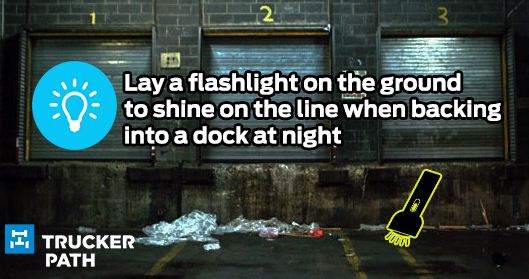
Some receiving docks are poorly lit, making it difficult for drivers to back a load in. Try laying a flashlight on the ground shining towards your truck to illuminate the lines and provide you with the necessary light to back in your trailer into the dock. (Credit: Jon Jones-Facebook).
One truck driver trip you should never overlook is to not be afraid to not know. It’s nearly impossible for anyone to know everything without some sort of assistance. Don’t risk it to chance. If you are unsure of something, ask. There is a community of drivers who not only share the road but can share valuable lessons from experience too.
Sure, Ice Road Truckers on the History Channel makes traveling on icy roads look easy but it’s not. Having a large bag of salt can help you get out of a bind during those winter month full of slick roads. Salt not only lowers the freezing point and melts snow, it also provides traction for your tires after the ice melts.
This truck driver tip should go without saying but we will anyway. Please do not rush yourself or drive recklessly. Keep your eyes on the road and give yourself plenty of distance to break or maneuver.
Truck Path is an indispensable tool for drivers that is used and updated by over 450,000 truckers. Whether you want to find available truck parking to rest up, check to see if a weigh station is open or compare diesel fuel prices, we can help make your life easier on the road and get you back home quicker to the ones you care about most.




Winter Driving Tips for Truckers
[p]Winter is here bringing with it the end of yet another year. For truck drivers though, winter is no different than any other season. It is the same endless driving through city and country roads no matter the season. The only thing that changes is the way you drive because winter brings rain and snow resulting in wet and slippery roads throughout the country. You need to be extra careful and exercise patience as the odds are stacked against you when it comes to driving in winter. Accidents are not uncommon, with many truckers trying their best to meet delivery deadlines. In such perilous conditions, there are certain protocols to follow, including changing your driving style. Let's talk about what else you can do as a trucker to improve your chances of meeting deadlines this winter.
[/p]
<h2></h2>
[p][b]Focus on the Road [/b][/p]
[p]If the road is slippery, you need to keep both your hands on the steering wheel and focus on the road. A slight shift in focus, and the next thing you know, your truck has lost control. You mustn't be distracted by anything, be it music, the radio, or anything else.[/p]
<h2></h2>
[p][b]Reduce Speed [/b][/p]
[p]Yes, you need to meet your delivery deadlines, and for that, you need to drive at a certain pace. But you know what they say, it is better to arrive late than never. Therefore, reduce your truck's speed, judge the road's condition, and increase speed only when it is safe to do so. If you drive slow, you can stop earlier and avoid getting into any accidents. [/p]
[img src="https://truckerpath.com/uploads/2020/12/TP-BLOG-Winter_Driving_Tips_for_Truckers-Reduce_Speed.jpg" alt=""]
<h2></h2>
[p][b]Avoid Sudden Maneuvers[/b][/p]
[p]To protect yourself and others on the road, you should drive a bit smoothly. That means you should accelerate slowly, brake easy, and turn with caution. Do nothing that would decrease your truck's traction and cause you to lose control of your vehicle. It is good practice to keep more than a safe distance between you and the other vehicle in front of you so you can react at the right time. [/p]
<h2></h2>
[p][b]Use Lights [/b][/p]
[p]Your truck's headlights, taillights, and fog lights are your dearest friend in harsh weather conditions. Poor lighting is a recipe for disaster, therefore before you set out on the road, inspect your truck's lights. The important thing here is that while you should be able to see the cars in front of you, others should also be able to spot you from behind. [/p]
[img src="https://truckerpath.com/uploads/2020/12/TP-BLOG-Winter_Driving_Tips_for_Truckers-Use_Lights.jpg" alt=""]
<h2></h2>
[p][b]Signal in Advance[/b][/p]
[p]Use your signals way before you intend to turn. As a general rule, wait for four to five blinks before gradually turning a corner or changing lanes. If you are driving slower than the traffic, we suggest you switch on your four-way hazard lights to let everyone else know that you are slow allowing them to make adjustments. [/p]
<h2></h2>
[p][b]Watch the Other Truckers [/b][/p]
[p]Veteran truckers are on the road for a reason. They have been trucking for so long that their experience counts for everything. As a beginner, you should learn from them. When big-rigs slow down or pull over, you should too. There is no reason to keep on going if everyone else has decided to call it a day. [/p]
[img src="https://truckerpath.com/uploads/2020/12/TP-BLOG-Winter_Driving_Tips_for_Truckers-Watch_Other_Truckers.jpg" alt=""]
<h2></h2>
[p][b]Check the News and Weather Apps[/b][/p]
[p]It is better to be safe than sorry, especially when it comes to trucking. Therefore, before setting out on your journey, watch the news, check some weather apps, or talk to other truckers who have taken the route you are intending to take. Leave the safety of wherever you are only when you are sure that it is safe to drive. [/p]
<h2></h2>
[p][b]Try for Traction [/b][/p]
[p]When it comes to driving on slippery roads, traction is everything. You need good tires, expert driving skills, and some good luck to make it through winter. The only thing you have under your control among the three is tires. Buy snow tires with a deep tread and with several grooves to get good traction[/p]
[img src="https://truckerpath.com/uploads/2020/12/TP-BLOG-Winter_Driving_Tips_for_Truckers-Try_for_Traction.jpg" alt=""]
<h2></h2>
[p][b]Final Thoughts[/b][/p]
[p]If it were up to us, we would recommend not driving in winter, but that's for you to decide. Winter driving is dangerous, and no matter what you do, there is always a very high risk of getting into a sticky situation. However, if you do decide to weather through the storm in your truck, then avoid high-risk highways.
[/p]
[p]You want to avoid the state of Michigan, Pennsylvania, and New York during the winter, and all the highways going around and through these states. Let's not even talk about Alaska, as that is one place that is always a high risk regardless of the season.
[/p]
[p]With that said, we wish you a safe winter driving season! What are your winter driving tips? Share them in the comments below. [/p]
<h2></h2>
<h2></h2>
[p][b]By Aldous Aldwin[/b][/p]
Trucker Spotlight - Vicki Simons <em>The Trucker Spotlight series explores the lives of truckers and their journey to make a difference in their industry. We interview different people in the trucking industry to understand some life lessons that make them who they are today. We also learn more about their motivations, and the problems that they encounter on the job. We also tackle how Trucker Path's solutions helped them with what they do. The information that they provide helps inform other people who are looking to delve into the trucking world.</em>
<h2></h2>
<h2></h2>
Today we are putting the spotlight on <strong>Vicki</strong>.
<h2></h2>
<strong>Introduction</strong>
<h2></h2>
My name is Vicki Simons.
<h2></h2>
While living in our first company-issued truck full-time in the early 1990s, my husband Mike and I learned quickly that some of the products that are marketed and sold to truckers are what we concluded to be cheaply made but expensive to buy trucker junk.
<h2></h2>
In those days, technology was not as advanced as it is now, so the only options open to us -- to cook food in our truck -- were 12-volt appliances.
<h2></h2>
One appliance that we felt would serve us well was a 12-volt "hot pot."
<h2></h2>
Because these units were constructed with no temperature control, the units were either "all on" or "all off."
<h2></h2>
So, they burned out quickly.
<h2></h2>
The warranty -- if there was one at all -- was usually either 30 or 90 days.
<h2></h2>
Because there were no other cooking solutions that we knew of at the time, we ended up going through eight -- yes, eight! -- of those units.
<h2></h2>
I was very upset and I kept thinking, "You know, someone ought to do something about this."
<h2></h2>
Oh, sure, there were occasional articles in trucking magazines that were geared toward helping truckers save money, but after searching for a long time, I found no resources that focused on this topic.
<h2></h2>
I kept feeling the Lord directing me toward being a "trucker consumer advocate" to help keep truckers from being stung financially.
<h2></h2>
So with Mike's consent, I spearheaded a website that we envisioned being a clearinghouse of how professional truck drivers from around the world save money -- in order to help each other save money.
<h2></h2>
That website is:
<a href="https://www.Truck-Drivers-Money-Saving-Tips.com/">Truck-Drivers-Money-Saving-Tips.com.</a>
<h2></h2>
I have been a professional truck driver and Mike's home support team member, both in-truck as a passenger and at home while he's been on the road as a solo trucker.
<h2></h2>
With nearly 20 years of professional truck driving experience between us -- and my insatiable appetite to research and write in such a way that helps others -- our website has grown to well over a thousand pages.
<h2></h2>
Every week since 2010, I have written multiple tips and inquiries in order to help truckers save money.
<h2></h2>
And every week since 2017, I have written a weekly trucking commentary entitled TDMST Weekly Round-Up.
<h2></h2>
<h3></h3>
<h3><strong>Tell us a short story about you. Any trivia? </strong></h3>
<h2></h2>
My husband Mike and I had both earned college degrees before we became a professional truck driving team.
<h2></h2>
After graduating from truck driver training school, we began orientation at a large trucking company.
<h2></h2>
On the very first day of orientation, there were 5 prospective truck drivers in the class.
<h2></h2>
We were told by the "Orientation Director" that in 45 days, 3 of the 5 of us would not be with the company!
<h2></h2>
Ouch!
<h2></h2>
I determined that with all of the time and money we had spent to get to that point, Mike and I were going to be the two who would succeed!
<h2></h2>
And we did!
<h2></h2>
<h2></h2>
<h3><strong>In the years that you have been driving, what are the significant changes that you've
noticed in the trucking industry?</strong></h3>
<h2></h2>
The most significant changes I've noticed in the trucking industry since the 1990s have been:
<h2></h2>
<li>increasing regulations;</li>
<li>more advanced technology; </li>
<li>a desire among some cheapskates to want to replace human truckers with machines (so that they don't have to pay people to move freight); and</li>
<li>some truckers relying too much upon GPS units not geared for commercial motor vehicles -- and as a result, being involved in many completely preventable accidents, including:
<h2></h2>
<ul>
<li>hitting low clearances,</li>
<li>collapsing bridges on non-truck routes, and</li>
<li>getting stuck in places where big trucks are not supposed to travel.</li>
</li>
</ul>
<h2></h2>
<h3><strong>What made you decide to be a trucker before?</strong></h3>
<h2></h2>
Originally, we thought that Mike would be the only trucker in our family.
<h2></h2>
When we visited with a truck driver training school recruiter, he asked Mike if I was going to drive, too.
<h2></h2>
The thought of me driving a big rig surprised me greatly, but the option was made available.
<h2></h2>
With a great deal of prayer and consideration, it made sense to us that if we were going to be together on the road, both of us should know how to drive a truck.
<h2></h2>
<h2></h2>
<h3><strong>Tell us a story about you and your husband and how you tackle the trucking industry?</strong></h3>
<h2></h2>
The way that I have tackled the trucking industry is by publishing -- so that others can learn from -- the true accounts that:
<h2></h2>
<li>we have had on the road and </li>
<li>which we have learned from others (including Mike's co-workers).</li>
<h2></h2>
I ask a lot of questions, including on our website and through my TDMST Weekly Round-Up trucking commentaries.
<h2></h2>
From my unique perspective, I've also written numerous comments to the FMCSA about various types of proposed trucking regulations
<h2></h2>
<h2></h2>
<h3><strong>What are your trucking pet peeves?</strong></h3>
<h2></h2>
I have a number of trucking "pet peeves," including:
<h2></h2>
<li>people who make decisions affecting truckers who have never spent a day in their lives as truckers;</li>
<li>regulations that treat people like robots; </li>
<li>the push toward self-driving, driverless, and autonomous trucks; </li>
<li>truckers who haul illegal drugs and smuggle illegal aliens;</li>
<li>truckers who set themselves up for failure, such as by engaging in distracted driving and/or not maintaining proper following distance; and</li>
<li>truckers who blindly follow GPS units -- especially those that are not designed for commercial motor vehicles -- and end up in completely preventable accidents.</li>
<h2></h2>
<h2></h2>
<h3><strong>What made you go into blogging?</strong></h3>
<h2></h2>
I began <a href="https://www.Truck-Drivers-Money-Saving-Tips.com/">Truck-Drivers-Money-Saving-Tips.com</a> as a rant against cheaply made but expensive to buy trucker junk, the first of which was a series of 12-volt "hot pots."
<h2></h2>
Because these units were constructed with no temperature control, the units were either "all on" or "all off."
<h2></h2>
So, they burned out quickly.
<h2></h2>
The warranty -- if there was one at all -- was usually either 30 or 90 days.
<h2></h2>
Because there were no other cooking solutions that we knew of when we started in trucking in the early 1990s, we ended up going through eight -- yes, eight! -- of those units.
<h2></h2>
Since we started our website, we have grown it to well over a thousand pages, including:
<h2></h2>
<li>a huge number of pages filled with information and truck drivers money saving tips, </li>
<li>lots of reviews, and </li>
<li>contributions from our readers. </li>
<h2></h2>
<h2></h2>
<h3><strong>Do you have a favorite truck model/brand?</strong></h3>
<h2></h2>
The only brand of truck I've ever driven professionally has been Freightliner.
<h2></h2>
Therefore, I have no other brand with which to compare the Freightliners I have driven or lived in.
<h2></h2>
In general terms, I believe that trucks driven by regional or long-haul truckers should be equipped with enough space and conveniences so that each trucker can work, sleep, and live comfortably on the road.
<h2></h2>
Concerning tractors with sleeper berths, I consider the following options to be critical for trucker well-being:
<h2></h2>
<li>a minimum of 1500 watts AC (alternating current) interior power (to let truckers operate cooking appliances and use other electronic devices);</li>
<li>reliable, non-battery-dependent climate control for both cooling and heating (to let truckers rest and sleep comfortably); and</li>
<li>an in-truck toilet (whether portable or not).</li>
<h2></h2>
<h3><strong>Could you identify the current pain points in the trucking industry? And maybe some suggestions on how to fix them?</strong></h3>
<h2></h2>
As of late 2020, these are the current pain points I see in the trucking industry:
<h2></h2>
<li>Electronic Logging Devices (ELDs);</li>
<li>the Hours of Service regulations; </li>
<li>problems with broker transparency; and</li>
<li>the fact that the U.S. federal agencies that are supposedly devoted to motor carrier "safety" and the "transportation" of goods in our country do not seem to be standing up for truckers as they face problems on the road.</li>
<h2></h2>
Because the FMCSA is influenced by many people who have never spent a day in their lives as truckers, I believe a lot would change for the better if every agency employee was required -- every year -- to spend a minimum of one week with an experienced trucker, so that they can understand life from a trucker's perspective.
<h2></h2>
<h2></h2>
<h3><strong>What keeps you busy nowadays? </strong></h3>
<h2></h2>
As of late 2020, I have in the works two books:
<li>one for aspiring truck drivers and</li>
<li>one for those who are already professional truckers.</li>
<h2></h2>
<h3><strong>Did it ever cross your mind to be a CDL instructor?</strong></h3>
Yes, and to a certain extent, I consider that I am a CDL instructor because of the information that I provide on our website.
<h2></h2>
<h3><strong>Do you have a favorite truck stop? Also truck stop meal?</strong></h3>
Based on changes at both the corporate and management levels over the years, I will not name a specific truck stop as my favorite.
<h2></h2>
Whether at a truck stop or other restaurant, Mike and I always enjoy a perfectly flavored and cooked steak, together with all of the side dishes.
<h2></h2>
<h2></h2>
<h3><strong>What are some tips that you would like to share for aspiring truckers? Also some tips and things to look out for based on your recent experiences.</strong></h3>
<h2></h2>
I will go into a lot more detail about tips for aspiring truckers in one of my upcoming books.
<h2></h2>
However, the one big overview tip that I will give to prospective truckers -- because trucking is different from every other kind of job out there -- is to make absolutely sure you're cut out for the trucking lifestyle before you start down that path.
<h2></h2>
For example, regional and long haul truckers are required to sleep away from home, usually in the truck they drive, wherever they park, during their sleeper berth break.
<h2></h2>
<h2></h2>
<h4>Vicki Simons</h4>
<a href="https://www.Truck-Drivers-Money-Saving-Tips.com/">http://Truck-Drivers-Money-Saving-Tips.com</a>
<h3></h3>
<h3></h3>