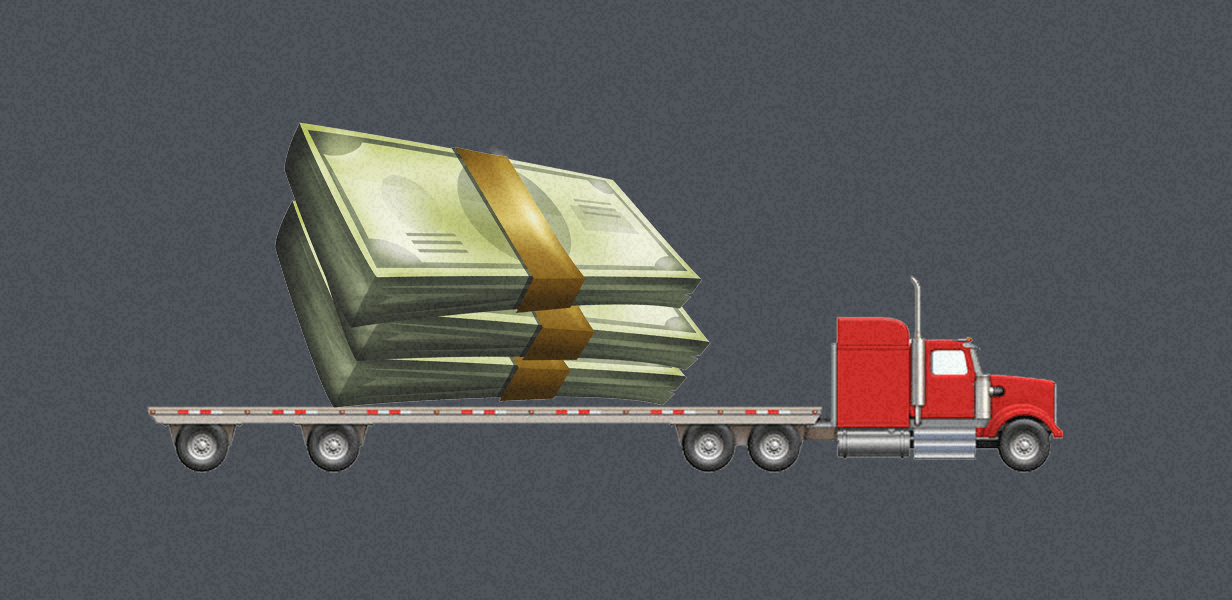
Using a reliable freight factoring company like Trucker Path InstPay is a great option for owner-operators to better manage their cash flow. However, not all factoring companies are created equal. Here are five things that make InstaPay the best freight factoring company for you.
Our non-recourse factoring means we assume liability to collect from your clients. We pay you for your invoices and we assume the risk to collect, not you. Choosing to factor with our factoring company allows you to operate risk-free and focus on running your business of hauling loads. Send us your bill of lading and rate confirmation right after you haul and we’ll get you paid!
It’s all in our factoring company name. With InstaPay, you no longer have to wait 30 or more days before getting paid by your clients. Our factoring company pays you within a day after hauling a load. it’s instant!
Our factoring company charges a one-time, flat rate which means there’s only a one-time charge of a small percentage of the invoice total. There are no hidden costs and you won’t be charged for ridiculous factoring fees that other factoring companies will.
We even offer a special rate on your first load and discounts for referring friends who want to use a freight factoring company like InstaPay as well!
There are no contracts or commitments with InstaPay, just a short list or terms to agree to. We don’t require you to factor with us for a specific amount of time or require a minimum volume. There is no fine print to worry about. We pride ourselves on being completely transparent.
You’ll never be forced to factor a specific volume or length of terms. Factor on your terms and use InstaPay anytime you want.
We know how busy you can be, especially when you’re always on the road. Factoring with InstaPay is easy to set up and even easier to use. Our user-friendly Truckloads app allows you to take pictures of your documents and send them right from your phone.
Don’t let your cash flow become an issue. Signing up with our factoring company is a breeze and you can get paid in a day! So what are you waiting for?
[button text=”Sign Up For InstaPay” href=”https://www.getinstapay.com” width=”250px”]


Recourse vs Non Recourse Factoring [p]Get paid in a day with freight factoring and understand the benefits and differences between recourse vs non recourse factoring.[/p]
[h2]Recourse vs Non Recourse Factoring[/h2]
[p]What's the difference between recourse vs non recourse freight factoring actoring? Say you're an owner-operator who's interested in freight factoring because you no longer want to wait 30 days to get paid for hauling a load. You come across a few factoring companies offering different rates and notice some are recourse factoring and others are non-recourse but don't know which freight factoring option is best.[/p]
[h2]Recourse Freight Factoring[/h2]
[p]With recourse freight factoring, you agree to sell your invoices to a factoring company that will then pay you after hauling a load (days to pay vary) however, you're responsible for collections from your client. Recourse factoring is commonly used in factoring finance however it presents the highest risk.[/p]
[p] Even if a recourse factoring company has taken on your invoice or provided you an advance, you are still liable if they are unable to collect from your clients. This puts your business at risk for a potential loss.[/p]
[h2] Non Recourse Freight Factoring [/h2]
[p]The opposite is true for non recourse freight factoring. When you sell your invoices to the factoring company, you are not liable to collect from your clients. Instead, the factoring company pays you after hauling a load and they assume the risk if your client fails to pay. Due to this, typically a non recourse factoring rate is slightly higher because the burden to collect is placed on the factoring company and not you.[/p]
[p] If you're an <a href="https://truckerpath.com/blog/how-to-become-an-owner-operator/">owner-operator</a> or manage a small fleet, it's usually more beneficial to choose non-recourse factoring in order to avoid a potential loss in revenue if there are complications with collections. Choosing a non recourse factoring company like Trucker Path InstaPay allows you to focus on running your business and haul more loads.[/p]
[button-green href="https://truckerpath.com/instapay/?utm_source=blog&utm_medium=recourseornonJuly5"]Learn about InstaPay[/button-green]
[video id=h3kXwM59BgM]
Industry Update - May 17, 2019 <h5>By Jeremy Feucht</h5>
<h3></h3>
<h3><strong><u>Did you Know?</u></strong></h3>
We are just under 7 months away from the final deadline of the ELD mandate. The grandfather clause that allowed drivers to continue to use their AOBRDs will expire on December 16, 2019.
<h3></h3>
<h3><strong><u>Trucking tip of the Week</u></strong></h3>
We are seeing record amounts of rainfall across the US. While stopping a big rig is difficult enough on dry roads, add in wet pavement after a hot spell, and vehicles with the best tires and breaks can have trouble stopping.
<h3></h3>
<h3><strong><u>Autonomous Vehicles</u></strong></h3>
More trouble for the autonomous vehicle industry as a <a href="http://fortune.com/2019/05/16/latest-fatal-tesla-crash-involves-autopilot/">Tesla was involved in another fatal accident</a>. The investigation results have become available in the fatal wreck and it has been determined that the autopilot was engaged but did not detect a semi. On March 1, a Tesla collided with the semi at about 68 mph while crossing a highway in Delray Beach, FL killing the driver of the Tesla. Events like this will further delay autonomous trucks from entering the industry.
<h3></h3>
<h3><strong><u>Tariffs </u></strong></h3>
Tariffs have been a common theme recently, but we may see a change to that. The <a href="https://menafn.com/1098536915/Trucking-Cheers-US-Agreement-with-Mexico-Canada-to-Lift-Tariffs">US has agreed to lift tariffs</a> on Mexico and Canada in regard to steel and aluminum that is manufactured in those countries. Further helping the trucking industry is that the agreement also includes the removal of retaliatory tariffs placed on US goods by Mexico and Canada. The removal of these tariffs should help reduce the costs to consumers and increase margins for the manufacturers which in turn should help stabilize or even increase rates paid to drivers.
<h3></h3>
<h3><strong><u>FMCSA Seeking Comments</u></strong></h3>
Last year, the FMCSA requested comments for a pilot program allowing those 18-20 years old with military experience to drive interstate. This week, the FMCSA is now requesting comments from anyone who would like to have their voice heard on allowing those 18-20 years old and without military experience to drive interstate. Currently those 18-20 can drive big rigs commercially, they just can only drive intrastate. If you would like to read the request by the FMCSA and comment, you can do so <a href="https://www.regulations.gov/document?D=FMCSA-2018-0346-0001">here</a>. Comments must be received by July 15, 2019.
How to Start a Trucking Company
[p]Wondering how to start a trucking company and earn more money? There are several steps and a few guidelines to follow. [/p]
[h2] How to Start a Trucking Company[/h2]
[p]Deciding to start a trucking company is a great idea and the timing is right. <a href="https://truckerpath.com/blog/trucking-industry-trends/">Trucking industry trends</a> expect freight revenue to grow by 75 percent over the next nine years and with the trucking industry eclipsing over $726.4 billion in revenue for 2015, starting a trucking company now can be extremely lucrative. The trucking industry serves as a pillar in keeping things going and as long as people have demand for products, moving freight will be necessary for years to come.[/p]
[p]Don't be intimidated by the larger trucking companies with thousands of truck drivers and investors to provide capital. 90 percent of trucking companies are small fleets of six trucks or less so there's space in the industry for you to learn how to start a trucking company.[/p]
[h2] 1. Apply for Trucking Authority - Trucking Company Forms[/h2]
[p]Paperwork, documentation, and forms. They're tedious and might seem redundant but are necessary for you to get your trucking company started and earn <a href="https://truckerpath.com/blog/trucking-authority/">trucking authority</a>.[/p]
[p]If you haven't already been assigned a US DOT number, you will need to register for a DOT number form before you can apply to obtain trucking authority. Keep in mind the old [a href="https://www.fmcsa.dot.gov/registration/form-mcs-150-and-instructions-motor-carrier-identification-report"]MCS-150 form[/a] is now only for updating existing US DOT number and not for obtaining a US DOT number.[/p]
[p]To get a US DOT number you will need to use the new [a href="https://portal.fmcsa.dot.gov/UrsRegistrationWizard/"]Unified Registration System[/a]. The processing time can take 20-25 business days according to the FMCSA.[/p]
[p]If you already have a US DOT number and wish to apply for operating authority you can do so by [a href="http://li-public.fmcsa.dot.gov/LIVIEW/PKG_REGISTRATION.prc_option"]completing this registration form[/a] and paying the associated $300 fee.[/p]
[h2] 2. Choosing a Process Agent[/h2]
[p]You will need to choose a process agent who can represent you in regards to court papers. You will need to have a process agent for each state your trucking company operates in. They are used if there ever is an issue where court papers are to be served to your trucking company in a state other than the state your company is registered in.[/p]
[p]The FMCSA has a [a href="https://www.fmcsa.dot.gov/registration/process-agents"]list of process agents to choose from here[/a]. The process agent is responsible for completing [a href="https://www.fmcsa.dot.gov/sites/fmcsa.dot.gov/files/docs/registration/1996/boc-3-1-18-2017.pdf"]Form BOC-3[/a] on behalf of your trucking company.[/p]
[h2]3. Truck Insurance[/h2]
[p]Once you've established your trucking company you will need to make sure that it's properly insured. Liability insurance is required for trucking companies to cover potential damages or injuries caused by operating a commercial vehicle.[/p]
[p]Shop around and get several quotes before making a decision on which insurance provider is best for your trucking company. [a href="https://www.fmcsa.dot.gov/registration/insurance-requirements"]Here is a detailed overview of the FMCSA insurance requirements[/a] to help get you started.[/p]
[giphy]<iframe src="https://giphy.com/embed/3o6Zt2iHqqrjNlbPS8" width="480" height="270" frameBorder="0" class="giphy-embed" allowFullScreen></iframe>[/giphy]
[h2]4. Buying or Leasing a Truck[/h2]
[p]When starting your trucking company you can buy or lease trucks depending on what suits your needs best. If you have the working capital upfront to cover the cost and want to operate a small fleet with a few trucks, buying several trucks at once from a dealer might result in a discounted price per vehicle.[/p]
[p]You can also look into leasing trucks which often times keeps the monthly costs down and can even have a lease-to-own option available. However, there are usually restrictions that apply to leasing that vary by dealer. You will want to take the time to search and compare dealer options and offers before choosing.[/p]
[p]Lastly, there is also the option to purchase used trucks which can help save you upfront but can be costly down the line. You may find a used truck that is a few years old with over 400,000 miles on it for $40,000 to $50,000 less than a new one.[/p]
[p]It might be a great deal but remember, on average, truck repairs cost an estimated $15,000 annually according to the ATRI and with used trucks, that number can be even more.
[/p]
[h2]5. Choosing the Right Truck and Trailer Equipment [/h2]
[p]
Choosing the correct equipment to haul <a href="https://truckerpath.com/blog/types-of-truck-freight/">truck freight</a> can have a tremendous impact on your trucking companies earning potential. Although freight rates fluctuate week-to-week, typically flatbed truck loads pay the highest rate on average.
[/p]
[p]
That is not to say that a reefer, van or step deck load won't ever pay a better rate. Rather it's just an overall average to consider before choosing the equipment type for your truck. Keep in mind that location also plays a major factor in determining freight rates.
[/p]
[p]<strong>Looking ahead</strong>: when you're trucking company is set up, you can find truck freight to haul on free load boards like <strong>Truckloads</strong>. Customize your truck load searches by <a href="https://truckerpath.com/blog/what-is-deadhead/">deadhead</a> location and the trailer equipment type for you. [/p]
[video id="snyBYpnuhWw"]
[h2] 6. International Registration Plan (IRP)[/h2]
[p]
By registering your vehicle through the IRP in your home state, you will be allowed to haul interstate loads as well as freight through Canada without having to worry about additional registrations. You will be provided an apportioned license plate and cab-cards now display all jurisdictions that you cover.
[/p]
[p]
The IRP registration fee for your apportioned plate will vary depending on state and vehicle weight, but typically the price ranges from $1,500 - $2,000. [a href="https://www.fhwa.dot.gov/about/webstate.cfm"]Use this list to determine what the cost will be for your state.[/a]
[/p]
[button-green href="http://vip.truckerpath.com/gold-member?utm_source=email&utm_medium=how-to-start"]Try Trucker Path Premium FREE for 14 Days[/button-green]