The misconceptions you hear from 4-wheelers about truck drivers can be laughable and frankly, absurd. At Trucker Path, we like to refer to these misconceptions of truck drivers as “Tales of an Uninformed 4-Wheeler”. Some are so crazy that all you can do is laugh at them.
Sometimes 4-wheelers just don’t understand what it’s like being a truck driver. Trucking requires learning an all new set of laws, regulations and the skill to drive an enormous big rig in some of the tightest spaces. It’s unlike any other career.
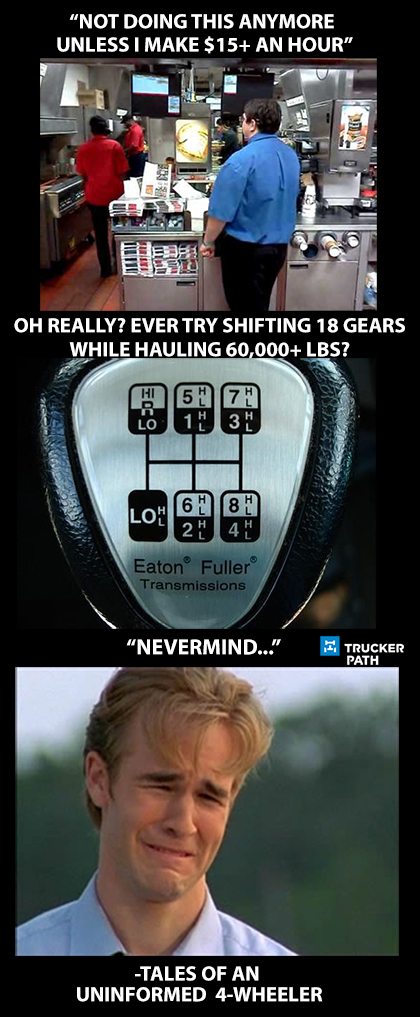
Why do trucks pass each other on the highway?
You hear this all the time. A 4-wheeler gets stuck behind a truck for a few seconds while the truck driver passes another big rig. There are several factors that play into this. It’s partly because some trucks are governed at a certain speed (some 60 mph) and some are governed at a higher mph or not at all. Also, some trucks carry much heavier loads than others. An incline in the road can also factor into this occurrence as some trucks hauling cargo uphill struggle to even go 50 mph. Due to this, some truck drivers have no choice but to pass a slower or heavier truck but at times, can only go a certain speed to pass.
Now the Department of Transportation has proposed a speed limiter for all commercial trucks weighing over 26,000 pounds. If the proposed truck speed limiters mandate passes, you will see a dramatic increase in this “inconvenient truck passing”.
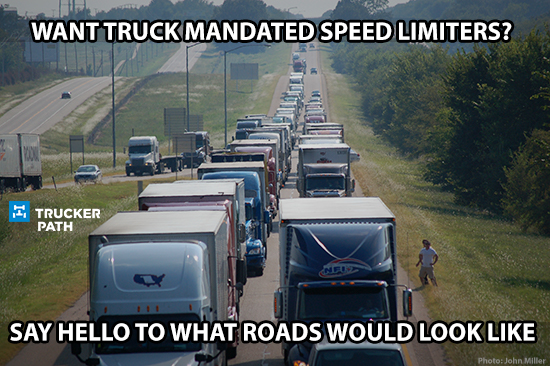
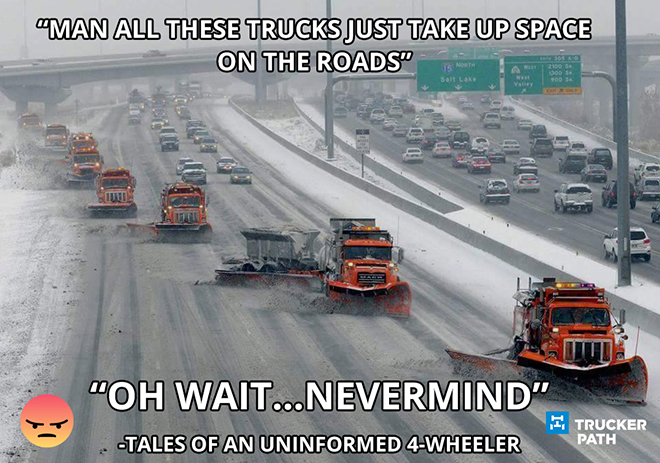
Then there are some 4-wheelers who think trucks are an inconvenience on the road altogether. Not only do truck drivers deliver 80 percent of all cargo in America, but they are used for disaster relief and various other tasks to make life easier for 4-wheelers.
Or the ones who think driving a truck is a simple job because all truck drivers have to do is sit in a chair.

Did we forget to mention that driving a truck is the deadliest job in America. In 2015, there were 745 truck driver fatalities, more than any other.
It’s time we debunk the myths about truck drivers. Don’t like trucks? Better rethink that one. Without truck drivers, shelves would be full of dust within a few days.



Spring Driving Tips for Truckers
[p]Spring is here and we are getting ready to welcome summer. Soon temperatures are going to soar, and rain will make its entry into the equation.[/p]
[p]As a trucker, it's both good and bad news for you. Good because you don't have to fight against snow or subzero temperatures anymore and bad because now rain, landslides, and other hazards will introduce themselves. Therefore, you must still be attentive when you drive your truck while also enjoying the scenic views the American highways have to offer. Let’s take a look at some of the challenges you might face driving in spring as a trucker.
[/p]
<h2></h2>
[p][b]Tackling Rain[/b][/p]
[p]At the start of spring and early summer, the weather begins to change, and with that comes rain and slippery roads. It shouldn't be too much of an issue driving in the rain because you are fresh off the winter season, and you must have tackled snowy roads during that period. However, you should exercise caution since roads become very slippery during the first few minutes of rain. You should slow down and maintain a safe distance from other trucks and vehicles on the road. If conditions are too treacherous and visibility is an issue, it is better to bide at a truck stop and wait for the storm to pass.[/p]
<h2></h2>
[p][b]Construction Season[/b][/p]
[p]The start of spring signals the beginning of the construction season, especially in the Midwest. If you
pass through a construction site, make sure to pay attention to all the road signs. You should slow down and change lanes with more care to avoid any accidents. If you practice caution, you will save others and yourself from unnecessary harm.[/p]
[img src="https://truckerpath.com/uploads/2021/04/202104-TP-BLOG-SpringTips-2.jpg" alt=""]
<h2></h2>
[p][b]Sun Glare[/b][/p]
[p]The sun shines bright during the spring and summer seasons. It also means that you have more hours of daylight to tackle. Therefore, keep a pair of sunglasses by your side to protect your eyes from damage - not to mention look cool as well. Furthermore, keep the truck's windshield clean, especially since bugs will also be aplenty during this time.[/p]
<h2></h2>
[p][b]Scenic Highways to Try This Season[/b][/p]
[p]Driving during spring season has some advantages too. You can also enjoy your time driving on scenic routes. Imagine getting paid to drive some of the most beautiful roads in America! Not everyone has that pleasure, so you must make the most out of it when you can.[/p]
<h2></h2>
[p][b]Route 12, Utah[/b][/p]
[p]The red rocks of Utah are a treat to watch, especially in early spring. The route presents exquisite views as you drive through the Canyons and wind down the challenging roads.[/p]
[img src="https://truckerpath.com/uploads/2021/04/202104-TP-BLOG-SpringTips-Cover-Route12Utah.jpg" alt=""]
<h2></h2>
[p][b]Trail Ridge Road, Colorado[/b][/p]
[p]It is extra fun to drive in high altitudes, especially in spring. The Trail Ridge Road is the country's highest continually paved road that follows through the Rocky Mountain National Park. You will get to see several wildlife species during your drive and witness outstanding scenery at every corner and straight.[/p]
[img src="https://truckerpath.com/uploads/2021/04/202104-TP-BLOG-SpringTips-Cover-TrailRidgeRoad.jpg" alt=""]
<h2></h2>
[p][b]Final Thoughts [/b][/p]
[p]The spring season is a good time for truckers as you can bask in the sun, enjoy scenic views, and make some good money while doing it. However, remember to take extra care and not be complacent while you are having fun. Do you have some awesome spring destinations? Share it with us.
[/p]
<h2></h2>
<h2></h2>
[p][b]By Aldous Aldwin[/b][/p]
Industry Update - June 2, 2020 <h2></h2>
<h3></h3>
<a href="https://truckerpath.com/uploads/2020/06/b21.jpg"><img src="https://truckerpath.com/uploads/2020/06/b21-300x156.jpg" alt="" width="300" height="156" class="alignleft size-medium wp-image-4991" /></a>
<h3><strong>DOT to Distribute 2.1 Million Masks to Truckers</strong></h3>
The U.S. Department of Transportation will distribute around 2.1 million face masks to truck drivers. This is part of a larger initiative to distribute masks to transportation workers across the country.
“Transportation workers are on the frontlines of keeping our transportation systems operational during this public health emergency and their wellbeing and safety is paramount,” said Transportation Secretary Elaine Chao.
DOT announced that the masks will be sent out over the coming weeks through the U.S. Postal Service. The breakdown of masks by transportation sector is as follows:
<ul>
<li>Mass transit and passenger rail – 4.8 million</li>
<li>Aviation – 3.8 million</li>
<li>Maritime – 2.4 million</li>
<li>Freight rail – 2.2 million</li>
<li>Highway and motor carrier – 2.1 million</li>
<li>Pipeline systems – 258,000</li>
</ul>
For detailed distribution locations and current dates of distribution, please visit: <a href="http://www.fmcsa.dot.gov/masks">www.fmcsa.dot.gov/masks</a>
<h2></h2>
<h2></h2>
<a href="https://truckerpath.com/uploads/2020/06/b19.jpeg"><img src="https://truckerpath.com/uploads/2020/06/b19-300x156.jpeg" alt="" width="300" height="156" class="alignleft size-medium wp-image-4988" /></a>
<h3><strong>Volumes Now Up 10% vs Last Year</strong></h3>
<a href="https://www.freightwaves.com/news/volumes-fall-week-over-week-but-now-up-10-year-over-year">Outbound tender volumes are benefiting greatly from the reopening of the economy</a> and a release of pent-up consumer demand. Supply dynamics are taking longer to adjust and capacity remains loose. While rates are coming off a depressed base, spot rates have surged to $1.47 per mile and have increased in the vast majority of lanes.
<h2></h2>
Volumes should continue to be supported by most of the states reopening, continued plugging of the income gap by generous unemployment benefits and stimulus, auto plants reopening, and produce seasons kicking into gear.
<h2></h2>
<h2></h2>
<a href="https://truckerpath.com/uploads/2020/06/b20.jpeg"><img src="https://truckerpath.com/uploads/2020/06/b20-300x156.jpeg" alt="" width="300" height="156" class="alignleft size-medium wp-image-4989" /></a>
<h3><strong>Blinking Lights Cut Tanker-Truck-Crashes By Nearly 34%</strong></h3>
As part of their safety efforts, Groendyke Transport installed $150 blinking amber lights to the back of their tanker trucks. They reported a 33.7% drop in rear-end collisions over a 31-month period, according to company officials. In addition, there were zero rear-end collisions at railroad crossing during a test period of one year and seven months.
<h2></h2>
The Groendyke Transport fleet currently has 900 trailers with the lights after almost three years of testing and now has <a href="https://beta.regulations.gov/document/FMCSA-2018-0223-0036">permission from FMCSA</a> to use them.
<h2></h2>
The cost of the strobe and installation is about $150.
<h2></h2>
<h2></h2>
<h2></h2>
<h4>By Aldous Aldwin</h4>
<h3></h3>
<h3></h3>
7 Tips on Healthy Eating For Truck Drivers [h2] Healthy Eating for Truck Drivers [/h2]
[p]It's never too late to rediscover healthy eating habits especially healthy eating for truck drivers. Here are seven tips to help promote better nutrition and healthy eating for truck drivers.[/p]
[p]Sure, it's easy to swing by a [a href="https://app.appsflyer.com/com.sixdays.truckerpath?pid=Social Facebook"]truck stop near you[/a] and grab a few cheese-smothered chili dogs, but that offers no nutritional benefits to healthy eating for truck drivers. The goal should be to create healthy habits and make it a lifestyle. These habits should be deeper than just what you eat, but also when you eat and how your shop for your food.[/p]
[h2]1. How Often Should I Eat?[/h2]
[p]Before we talk about shopping and cooking we should talk about something extremely important: eating. Our society and the trucking industry has been organized around the idea that people should only eat about 3 times a day. For healthy eating for truck drivers, this is not necessarily the best choice. [/p]
[p]While this might be more efficient in terms of consuming maximum calories in minimum time and getting back on the road, it is not always the best plan for your health. Instead, aim for around five smaller meals each day. This might seem crazy but it is necessary to metabolize food more efficiently.[/p]
[h2]2. How Our Body Processes Food[/h2]
[p]Your body is designed to absorb calories, use them for energy and then burn them off. In order for your body to make use of the food, what you eat has to be broken down into a form of sugar called glucose. This is a natural process and for most, the human body does this quite well. You have probably heard people talking about their “blood sugar level”, and what they are referring to is the amount of glucose in their blood.[/p]
[giphy]<iframe src="https://giphy.com/embed/kVVEP6SmfEXvy" width="480" height="269" frameBorder="0" class="giphy-embed" allowFullScreen></iframe>[/giphy]
[h2]3. Why Should I Care About My Blood Sugar Levels?[/h2]
[p]Your body has a normal range for the amount of [a href="https://thehungryhauler.com/"]glucose in your blood[/a] (between 4.0 and 11.0) and it has a beautiful system for managing that level. Hormones like insulin keep your blood sugar from getting too high and becoming toxic, and another awesome compound, glucagon keeps your sugar from getting too low and making you pass out. It is something like a highway with really good guard rails that keep a truck from running off the road.[/p]
[p]The only problem is that it is possible to overwhelm this excellent system and cause a wreck. Actually, many people are overwhelming it every day and causing small “fender benders” that lead to a total cataclysm later in life called diabetes.[/p]
[p]So why does this make eating only three times per day (or fewer) a bad idea? Because you can end up constantly overwhelming the system with extreme blood sugar highs and lows. If you wait to eat until you are extremely hungry and have very low blood sugar, your body will send the signal that you are starving, and when you do eat it is often much easier to overeat unhealthy and convenient food. Healthy eating for truck drivers requires you to eat when you're hungry and avoid a severe dip in blood sugar.[/p]
[h2]4. How Much Should I Be Eating?[/h2]
[p]Some people conclude that the solution is to simply eat drastically less overall and there is a grain of truth to this. While dramatically reducing your caloric intake does cause the body to burn stored fat to stay alive, it can signal your body to store everything you do eat, which results in rebound weight gain when you do return to a more normal diet. Starving yourself is not the answer.[/p]
[p]Thankfully there is a much better way. Simply, eat a reasonable amount of food more often. Eating five or six smaller and healthier meals per day is like steering down the middle of your lane instead of bouncing your truck off the guard rails all day. This practice will help you feel more content and stop your body from deciding to store fat for hibernation. Of course, if you eat more often and end up eating more food overall you will still have trouble being healthy. The objective is to eat an appropriate amount of food, in a more sustainable way. Typically, 2,000–2,500 daily calories are suggested; however, consulting a healthcare professional is the best way to understand what an appropriate daily caloric intake means for your individual health needs.[/p]
[giphy]<iframe src="https://giphy.com/embed/xtgZt3jZelFqU" width="480" height="269" frameBorder="0" class="giphy-embed" allowFullScreen></iframe>[/giphy]
[h2]5. What Are the Benefits to Eating More Often?[/h2]
[p]There is also an enormous safety benefit to eating more often and avoiding the blood sugar spikes: you are less likely to feel drowsy at the wheel. Most people have experienced the after dinner slump that makes it all but impossible to keep your eyes open after a big meal. That might be fine after Christmas dinner when you are lounging on the couch at home, but at work, behind the wheel of an 80,000 pound-plus rig, it can be a disaster.[/p]
[h2]6. How Do I Plan My Meals?[/h2]
[p]You might be wondering: how on earth is it possible to eat five or more meals per day? Who has the time to stop for food that often? There is a way to make your diet much simpler, more healthy, easier to sustain over the long term, and much less expensive! The key is to learn to shop for your own food and cook for yourself on the road. It is much easier than it may sound, and the rewards for your health and happiness are amazing! It will even allow you to have more freedom to implement your doctor's specific recommendations.[/p]
[h2]7. Eat What You Want. Sort of[/h2]
[p]Anyone who has dealt with eating healthier has heard the term portion control. Controlling what, how much, how often you eat and making sensible, sustainable choices is the path to solving many of the health risks of the trucking lifestyle. To eat healthier you don't have to give up all of your favorite foods and consume a spinach and carrot based diet like a rabbit. Instead of going to the extreme, eating a balanced diet will keep you “between the lines” and on the road to better health. Extremes are by nature quite unsustainable and will not help you. Just like over-steering on the highway to avoid a crash can actually end up killing you, bouncing from one diet extreme to another, like chili-dogs to rabbit food, will just leave your lifestyle in a bewildering wreck.[/p]
[giphy]<iframe src="https://giphy.com/embed/n2v0V9cSmTQnS" width="480" height="269" frameBorder="0" class="giphy-embed" allowFullScreen></iframe>[/giphy]
[p]The cornerstone of a healthy life is healthy eating for truck drivers. Eating healthy is difficult for truck drivers who are on the road for weeks at a time. Most trucks aren’t designed with a fully equipped kitchen or proper food storage. Even if you can manage to find space for some cooking gear, it is often difficult to consistently find time in a busy schedule to prepare a good meal. We all want to be around long enough to enjoy time with our families and loved ones. The best way to ensure this is to focus on eating healthier as a truck driver.[/p]
[p]By: [a href="https://thehungryhauler.com/"]John Heslop[/a][/p]