Here’s a closer look at the trucking industry statistics highlighting the significance of the backbone of America – truckers.
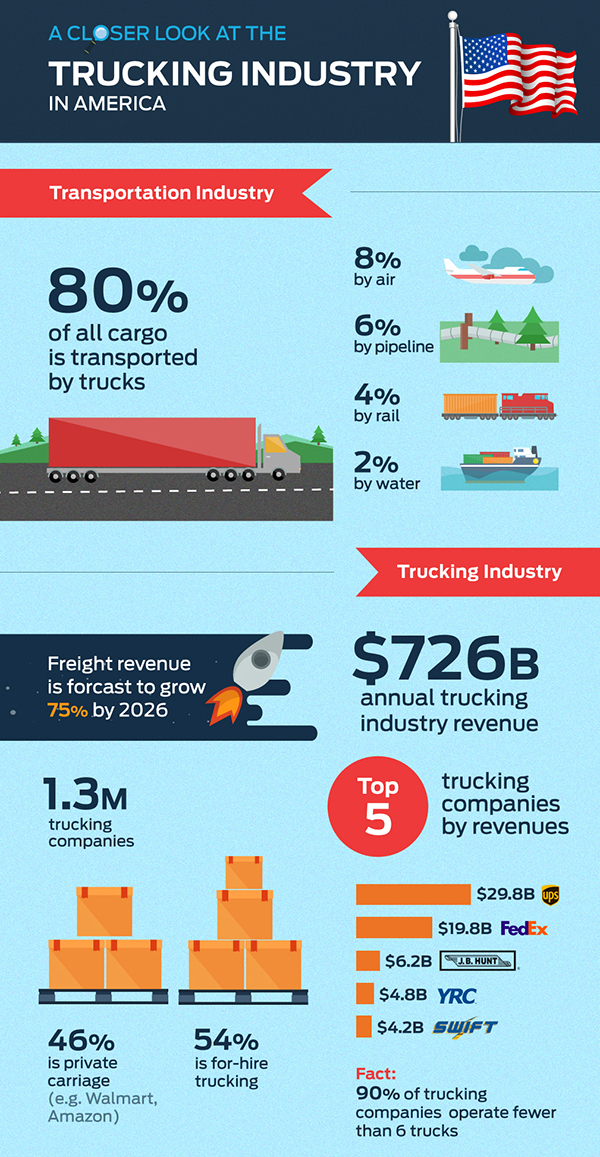
The trucking industry statistics are truly remarkable. It’s an industry topping $726.4 billion in revenue for 2015 and responsible for six percent of all jobs in America.
If you bought it, they brought it. Truck drivers keep America rolling by driving countless and lonely hours delivering the cargo we desire. Without trucks to ship things, those shelves would be mighty bare and those same-day delivering services from your online shopping wouldn’t be possible without truckers.
Don’t believe us? Check out the trucking industry statistics.
Merge onto any highway and you’ll see countless semi trucks heading in either direction of the road. Seems like they’re endless amounts of them right? You would be correct, in fact 80 percent of all cargo in the USA!
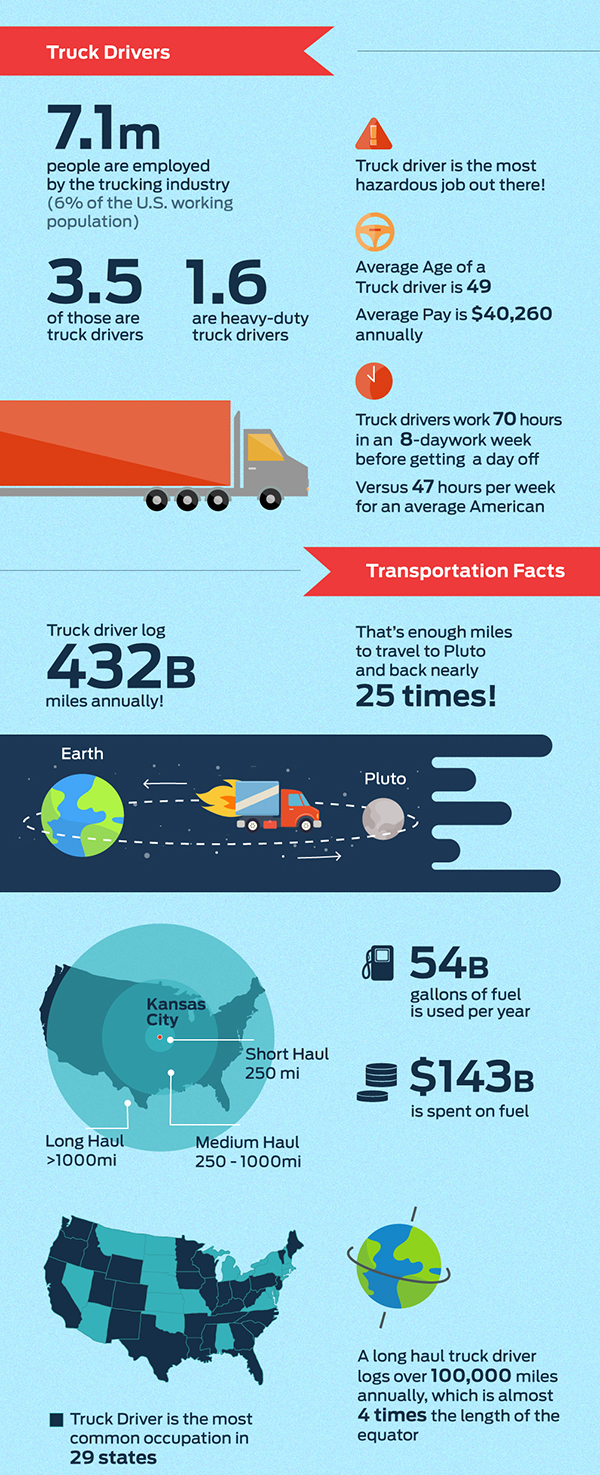
There are 3.5 million truck drivers in the trucking industry who put their life at risk delivering an array of commodities and goods. Drivers operate heavy-duty trucks with a load weighing as much as 80,000 pounds. In 2015, 852 truck drivers lost their life while working, making truck driver the most dangerous job in the USA. So remember to give truck drivers space and don’t tailgate.
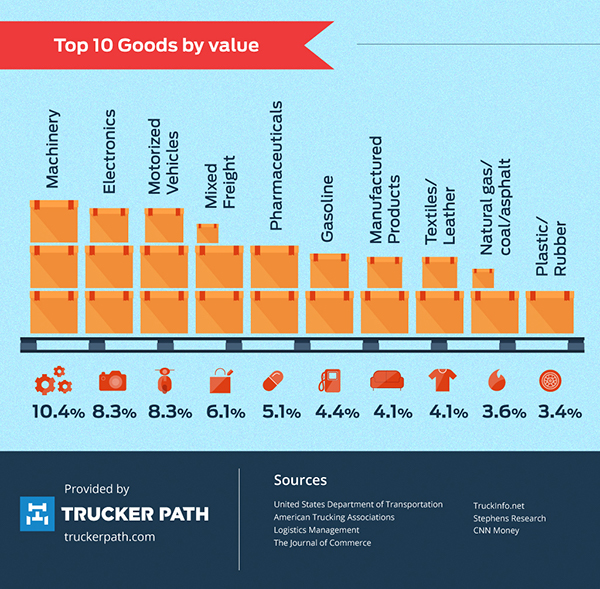
Truck drivers haul a variety of goods with machinery, electronic and motorized vehicles making up 27 percent of goods shipped by truck drivers in America. The most common thing trucks haul is machinery, followed by electronics and motorized vehicles. Additionally, mixed freight includes commodities such as food and restaurant supplies.
Let’s face it, without the trucking industry we wouldn’t be able to enjoy the things we have. Shelves would be empty and people would undoubtedly be in a state of panic if that happens. The trucking industry statistics don’t lie!




ELD Mandate Exemptions [p]Get clarification on electronic logging devices and ELD mandate exemptions set to take effect in December 2017. [/p]
[h2]ELD Mandate Exemptions[/h2]
[p]As of December 18, 2017, most drivers that currently use paper logs will have to switch over to an electronic logging device. The choices will be an automatic onboard recording device (AOBRD) meeting the current requirements in §395.15, installed before December 18, 2017, or a device meeting the electronic logging device (ELD) standards found in Subpart B to Part 395 and the associated appendix.[/p]
[p]There are <strong>five ELD Mandate exemptions</strong> including:[/p]
[ul]
[li]Drivers that only had to fill out a log eight or fewer days out of the last 30 days. This would include “short-haul” drivers that normally operate under the 100 and 150 air-mile exceptions and intermittent drivers.[/li]
[li]Drivers operating a vehicle older than the model year 2000. This also applies to the model year 2000 and newer vehicles that do not have the original engine in them, if the engine serial number indicates that the engine is older than the model year 2000. [/li]
[li]Drivers operating a vehicle that is part of a driveaway/towaway shipment. [/li]
[li]Drivers driving or towing a recreational vehicle that is part of a driveaway/towaway shipment.[/li]
[li]Drivers who are driving a truck that was rented for eight days or less. [/li]
[/ul]
[p]How are officers on the road going to verify that a driver claiming one of the exemptions is actually entitled to it? It is easier than you might think. [/p]
[h2]ELD Exemptions and Short-Haul Drivers[/h2]
[p]During a roadside inspection, the officer can contact the carrier for the time records related to a driver he/she is inspecting. The officer can then verify that the driver is complying with the terms of the 100 or 150 air-mile exemptions. This simply involves the officer verifying that there were time records and they showed the driver staying under the limits attached to the exemption. [/p]
[p]If the records show the driver as operating under the 100 or 150 air-mile exception often enough, there would be no violation for the driver not using an ELD.[/p]
[p]As far as intermittent drivers, the officer will inquire as to how many days the driver has worked out of the last 30. If it ends up to be 8 or fewer out of any 30-day period, there is no violation.[/p]
[h2]ELD Exemptions on Older Vehicles[/h2]
[p]To verify that the driver can use paper logs due to the age of the vehicle, the officer will simply check the vehicle identification number (VIN). If the VIN indicates that the vehicle is the model year 1999 or older vehicle, there will be no violation for the driver using a paper log rather than an electronic log.[/p]
[p]How is this determined? [/p]
[p]The model year is coded in the vehicle’s VIN at the 10th position. Presently, 2000 and newer vehicles have Y, 1 to 9, or A to H in the 10th position (i, o, u, and z are not used in VINs by the way). If the 10th digit is anything other than those listed, the vehicle is manufactured before 2000.[/p]
[p]In the case of the model year, 2000 or newer vehicle that has been retrofitted with the model year 1999 or older engine, to determine if the engine is manufactured before the year 2000, the officer will ask to see the engine serial number. Using the serial number and available software, the officer can quickly validate the engine model year.[/p]
[h2]Driveaway/Towaway ELD Exemptions[/h2]
[p]To verify that the driver is allowed to use the driveaway/towaway exception to use a paper log rather than an electronic log after December 18, 2017, all the officer or auditor needs to do is ask for the shipment paperwork. The shipment paperwork will then be used to verify that the vehicle the driver is operating is part of the shipment. If so, then there would be no violation for the driver using a paper log rather than an electronic logging device.[/p]
[h2]Rented Trucks[/h2]
[p]To verify that a driver is allowed to use the rented truck exemption, the driver must be able to present the rental agreement showing that the vehicle is being rented for 8 days or less. The driver must use paper logs and have records for the previous seven days. Printouts from an ELD system are acceptable. The exemption does not cover “leased” vehicles or vehicles rented for more than 8 days. Multiple back-to-back rental agreements will result in the carrier being cited for not using ELDs.[/p]
[h2]Still Confused about ELD Mandate Exemptions?[/h2]
[p]If you’re still confused about Exemptions to the mandate or wondering if you need to comply with the ELD mandate, contact J.J. Keller for a free ELD Exemption Assessment. Their ELD specialist will guide you through 21 questions created by their hours of service subject matter experts to help you determine if you are exempt from using ELDs. Call the ELD Exemption hotline at 888-531-8899 or <strong>request an assessment <a href="https://www.jjkeller.com/webapp/wcs/stores/servlet/infoform_10151_-1_10551_52145?cm_mmc=Misc-_-ELDExemptionAssessment-_-eldexempt-_-null">here</strong></a>.[/p]
[p]<strong>J. J. Keller & Associates, Inc.</strong>[/p]
[p]Since its beginning as a one-man consulting firm in 1953, J. J. Keller & Associates, Inc. has grown to become the most respected name in safety and regulatory compliance. Now over 1,400 associates strong, J. J. Keller serves over 600,000 customers — including over 90% of the Fortune 1000® companies. The company’s subject-matter expertise spans nearly 1,500 topics, and its diverse solutions include ELogs and mobile technology; training via online courses, streaming video or DVD; online management tools; managed services; consulting services; online and print publications; forms and supplies.[/p]
<strong>[p]About the Author:[/p]</strong>
[p]Tom Bray has been with J. J. Keller & Associates, Inc. for 11 years. However, as he does not get enough excitement working at J. J. Keller and chasing after six kids and nine grandkids, he also chooses to work nights and weekends as a firefighter/EMT.[/p]
Things to Consider When Buying Dashcams for Trucks
[p]Trucking is a challenging job that requires constant commitment and motivation from the part of the truck driver. It is your job as a trucker to keep the cargo, the truck, yourself, and other drivers safe on the road. However, sometimes accidents can occur, leading to the involvement of multiple parties like the police and the insurance companies. In such cases, it is always better to protect yourself from paying for unnecessary damages. The best way to do that is by installing a dashcam in your truck.[/p]
[p]There are so many dashcams for sale in the market that selecting the right one can be a troublesome task. Do not let that faze you. You can choose the perfect dashcam for your truck using the information provided in this article. So, without further ado let’s get started!
[/p]
<h2></h2>
[p][b]The Dashcam’s Resolution [/b][/p]
[p]The first thing you should consider when buying a dashcam for your truck is the camera’s resolution. There are dashcams out there that produce unclear videos then there are others that can record in HD resolution. When it comes to trucking you want to buy a dashcam with a high resolution so that all the recorded footage is of high quality. If you are required to present the video as evidence in the court then you would want the video to be as clear as possible and be able to capture essential information such as plate numbers or street signs. You could opt for 4k resolution dashcams, but they are highly expensive and chances are that you won't need such high resolution for your truck.[/p]
[p][b]Number of Point of Views [/b][/p]
[p]You want a dashcam that has more than two channels i.e. a dashcam that can show footage from at least two designated positions. A six-channel camera would show footage from a different location from inside and outside the car, which can be beneficial. A truck is huge and requires ample coverage which is why you need multiple channels.
[/p]
<h2></h2>
[img src="https://truckerpath.com/uploads/2020/10/TP-BLOG-Things-to-Consider-When-Buying-Dashcams-for-Trucks-The-Type-of-Lens.jpg" alt=""]
[p][b]The Type of Lens [/b][/p]
[p]A dashcam with a wide lens will show a larger area in the front of your truck. Cameras with a 120-degree field of view are ideal for trucking. As a rule of thumb, the larger the field of view the better but that is not always true. Dashcam lenses that are wider than 120 degrees will create a fisheye effect leading to very awkward footage. A 360-degree camera lens can help solve both problems. [/p]
<h2></h2>
[p][b]Connectivity [/b][/p]
[p]In this modern world, it is helpful if everything is connected to our phones or PCs. Therefore, a dashcam with a related mobile app can be very useful, especially if you are out & about and not near a PC. Furthermore, the mobile app can let you view the footage live and unaltered. So, even if you are away from your truck you are only a tap away from accessing the dashcam.[/p]
<h2></h2>
[img src="https://truckerpath.com/uploads/2020/10/TP-BLOG-Things-to-Consider-When-Buying-Dashcams-for-Trucks-Dashcam-Viewing-Screen.jpg" alt=""]
[p][b]Dashcam Viewing Screen [/b][/p]
[p]Some dashcams in the market have an LCD screen on their back so you can view the footage in real-time as you drive. That is not highly recommended, as a dashcam with an LCD can be distracting for you as a driver. They are big and bulky while also being too big to hide. Smaller dashcams with no LCDs are sleek and elegant making them the perfect choice for some truckers. The camera can be hidden from plain view allowing you to focus entirely on the road. [/p]
[p][b]User Friendliness [/b][/p]
[p]Dashcam installation can be hectic if you buy the wrong one. Many dashcams require you to connect electrical wiring and make adjustments in your truck. They are not very easy to install, which is why most truckers opt for dashcams that are operated by a battery or can easily plug in to a 12v socket. These kinds of dashcams do not require any complex installation and perform the same job as the other types. [/p]
[p][b]Dashcam Memory [/b][/p]
[p]You should also consider the memory capacity for your Dashcam. These cameras come with a micro SD card slot allowing you to save all the footage in one place so that you can transfer it later to a personal computer. Therefore, a dashcam should have the capability to accept high-volume memory cards such as 512 GB or 256 GB. This way, you’ll be able to record more footage and won’t have to worry about deleting often.[/p]
<h2></h2>
[img src="https://truckerpath.com/uploads/2020/10/TP-BLOG-Things-to-Consider-When-Buying-Dashcams-for-Trucks-Pricing.jpg" alt=""]
[p][b]Pricing [/b][/p]
[p]The last thing you should consider is the pricing. Dashcam prices range from $40 up to even $600. Treat your dashcam as a worthy investment that will save you money in the long run. Find a dashcam that gives you all the features that you’re looking for with a relatively cost efficient price. That way, you won’t have to think about upgrading in the near future. Do it once, and do it right.[/p]
[p][b]Conclusion [/b][/p]
[p]A dashcam is a simple gadget that has a lot of fancy features with a lot of good benefits especially for truckers. It is definitely worth considering to get to give you a bit of peace of mind when the unexpected happens.[/p]
<h2></h2>
<h2></h2>
[p][b]By Aldous Aldwin[/b][/p]