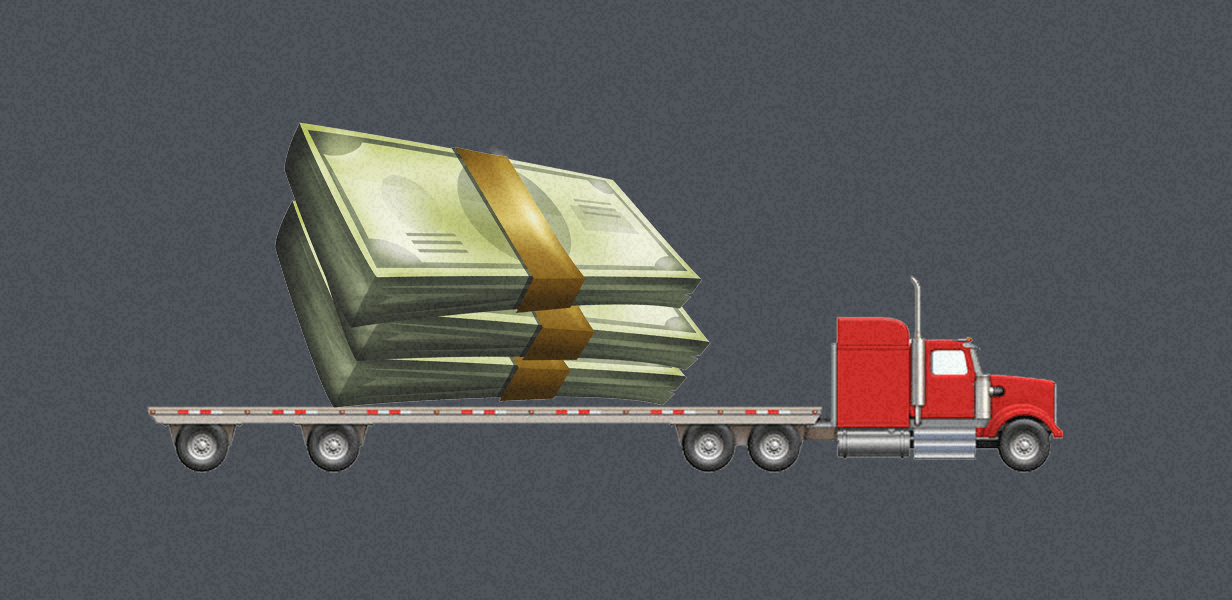
Using a reliable freight factoring company like Trucker Path InstPay is a great option for owner-operators to better manage their cash flow. However, not all factoring companies are created equal. Here are five things that make InstaPay the best freight factoring company for you.
Our non-recourse factoring means we assume liability to collect from your clients. We pay you for your invoices and we assume the risk to collect, not you. Choosing to factor with our factoring company allows you to operate risk-free and focus on running your business of hauling loads. Send us your bill of lading and rate confirmation right after you haul and we’ll get you paid!
It’s all in our factoring company name. With InstaPay, you no longer have to wait 30 or more days before getting paid by your clients. Our factoring company pays you within a day after hauling a load. it’s instant!
Our factoring company charges a one-time, flat rate which means there’s only a one-time charge of a small percentage of the invoice total. There are no hidden costs and you won’t be charged for ridiculous factoring fees that other factoring companies will.
We even offer a special rate on your first load and discounts for referring friends who want to use a freight factoring company like InstaPay as well!
There are no contracts or commitments with InstaPay, just a short list or terms to agree to. We don’t require you to factor with us for a specific amount of time or require a minimum volume. There is no fine print to worry about. We pride ourselves on being completely transparent.
You’ll never be forced to factor a specific volume or length of terms. Factor on your terms and use InstaPay anytime you want.
We know how busy you can be, especially when you’re always on the road. Factoring with InstaPay is easy to set up and even easier to use. Our user-friendly Truckloads app allows you to take pictures of your documents and send them right from your phone.
Don’t let your cash flow become an issue. Signing up with our factoring company is a breeze and you can get paid in a day! So what are you waiting for?
[button text=”Sign Up For InstaPay” href=”https://www.getinstapay.com” width=”250px”]




Recourse vs Non Recourse Factoring [p]Get paid in a day with freight factoring and understand the benefits and differences between recourse vs non recourse factoring.[/p]
[h2]Recourse vs Non Recourse Factoring[/h2]
[p]What's the difference between recourse vs non recourse freight factoring actoring? Say you're an owner-operator who's interested in freight factoring because you no longer want to wait 30 days to get paid for hauling a load. You come across a few factoring companies offering different rates and notice some are recourse factoring and others are non-recourse but don't know which freight factoring option is best.[/p]
[h2]Recourse Freight Factoring[/h2]
[p]With recourse freight factoring, you agree to sell your invoices to a factoring company that will then pay you after hauling a load (days to pay vary) however, you're responsible for collections from your client. Recourse factoring is commonly used in factoring finance however it presents the highest risk.[/p]
[p] Even if a recourse factoring company has taken on your invoice or provided you an advance, you are still liable if they are unable to collect from your clients. This puts your business at risk for a potential loss.[/p]
[h2] Non Recourse Freight Factoring [/h2]
[p]The opposite is true for non recourse freight factoring. When you sell your invoices to the factoring company, you are not liable to collect from your clients. Instead, the factoring company pays you after hauling a load and they assume the risk if your client fails to pay. Due to this, typically a non recourse factoring rate is slightly higher because the burden to collect is placed on the factoring company and not you.[/p]
[p] If you're an <a href="https://truckerpath.com/blog/how-to-become-an-owner-operator/">owner-operator</a> or manage a small fleet, it's usually more beneficial to choose non-recourse factoring in order to avoid a potential loss in revenue if there are complications with collections. Choosing a non recourse factoring company like Trucker Path InstaPay allows you to focus on running your business and haul more loads.[/p]
[button-green href="https://truckerpath.com/instapay/?utm_source=blog&utm_medium=recourseornonJuly5"]Learn about InstaPay[/button-green]
[video id=h3kXwM59BgM]
How to Start a Hotshot Trucking Business
[p]Ever wondered how to be your own boss while enjoying beautiful sceneries across America?
The freight industry is the backbone of America’s economy contributing more than <a href="https://tradingeconomics.com/united-states/gdp-from-transport">500 billion USD</a> every quarter and the numbers are increasing each year. It’s a lucrative industry which gives handsome rewards. However, it is not easy getting into traditional trucking due to the requirements needed.[/p]
[p]What if there was a way to be a part of the trucking industry without dealing with all the hassle? The good news is there is a sure-fire way of being a part of the trucking industry and you can get started in a few days. What is it, you ask? The answer to that question is “Hotshot Trucking”. But there are still a few requirements before you are eligible to haul freight. Fortunately, these requirements are easy to complete and we will explain everything step by step below.
[/p]
<h2></h2>
[p][b]What is Hotshot trucking? [/b][/p]
[p]Hotshot truck drivers are freelancers who work privately carrying freight from one point to the other without any employer restrictions or scheduling restrictions. In other words, you are your boss and you can choose when to earn and how much to earn. All you need is a medium or heavy-duty truck with at least 7,000 pounds of hauling force and a trailer. A Dodge Ram 3500, a Toyota Tacoma, or any version of the Ford F-series truck can work well. [/p]
[p]Currently, around 70% of the goods you can find on the shelves are transported by hotshot truckers and independent freight transporters. According to estimates, the trucking industry is expected to grow by 2.3% yearly till 2024. With freight volumes increasing day by day it is the perfect time to set up your own hotshot trucking business.
[/p]
[p][b]Pros and cons of Hotshot Trucking?[/b][/p]
[p]Hotshot Trucking comes with a lot of advantages especially if you want to kick-off your trucking business easily. But be wary also of some limitations and trade-offs when entering this kind of trucking business.
[/p]
[img src="https://truckerpath.com/uploads/2020/10/How-to-Start-a-Hotshot-Trucking-Business-pros_and_cons_table.png" alt=""]
[p][b]How to Begin?[/b][/p]
[p]Now that you have a basic idea of hotshot trucking let’s get started on the specifics: [/p]
<h2></h2>
[p][b]Set up an LLC[/b][/p]
[p]You need to set up a Limited Liability Company (LLC) and register it with your state. This is the first step in registering your business and it doesn't matter if you are working alone or if you intend to invite others to join in with you, setting up a legal company gives you many <a href="https://www.legalzoom.com/articles/advantages-of-an-llc">benefits</a> such as:[/p]
<ul>
<li>Limited personal liability</li>
<li>Less paperwork</li>
<li>Tax advantages</li>
<li>Ownership and Management flexibility</li>
<li>Flexible profit distribution</li>
</ul>
[p][b]Register With the Tax Authorities [/b][/p]
[p]Once you have your LLC set up, the next step is to get a <a href="https://www.irs.gov/individuals/international-taxpayers/taxpayer-identification-numbers-tin">Tax ID</a> to go with your business. The tax ID or the Employer Identification Number (EIN) will allow you to receive checks and other forms of payments directly to your business account. That takes us to our next step. [/p]
<h2></h2>
[img src="https://truckerpath.com/uploads/2020/10/How-to-Start-a-Hotshot-Trucking-Business-make_a_business_bank_account.jpg" alt=""]
[p][b]Make a Business Bank Account[/b][/p]
[p]A separate bank account will allow you to divert all your business-related transactions to your business bank account. This allows you to keep track of your expenditures while also giving you the liberty to make and receive payments.[/p]
[p][b]Apply for a CDL (optional)[/b][/p]
[p]Hotshot trucking does not require a commercial driver’s license (CDL) since in most cases you won’t be exceeding the gross weight limit determined by the authorities. [/p]
[p]You don’t need a CDL if: [/p]
<ul>
<li>If the total weight you are pulling is less than 10,000 pounds.</li>
<li>If the combined weight of the vehicle and trailer is less than 26,000 pounds. </li>
</ul>
[p]Getting a CDL is no easy task. You have to enlist in a reputable training academy, go through several weeks of training, and then apply as well as pass the CDL exam. Therefore, it is better to forego this requirement in the early stages of your business but its best to acquire the license once your business is up and running.
[/p]
<h2></h2>
[img src="https://truckerpath.com/uploads/2020/10/How-to-Start-a-Hotshot-Trucking-Business-acquire_relevant_equipment-1.jpg" alt=""]
[p][b]Acquire Relevant Equipment [/b][/p]
[p]As you know, hotshot trucking involves a lot of hauling and towing. It is important to have a sturdy and reliable truck if you want to save yourself a lot of grief later. You will need a good medium to heavy-duty truck with a lot of power (around 400HP) to pull at least a ton and a 30 ft. gooseneck flatbed trailer to begin. A decent truck can cost from $15,000 to $60,000. A good trailer costs from $7,000 to $25,000. It is up to you to decide how much you want to invest in the business initially. If you already have a truck at home and you don’t intend to get a CDL right away then you can save money by buying a cheap trailer and starting your business with minimum investment. [/p]
<h2></h2>
[p][b]Further Government Approvals [/b][/p]
[p]It is a good idea to register your business with the Department of Transport (DOT) in your state and also with the federal authority if you intend to drive interstate. The state will provide you a DOT number and the federal government authority will give you a Motor Carrier (MC) number. These numbers must be emblazoned on the side of your vehicle. [/p]
<h2></h2>
[img src="https://truckerpath.com/uploads/2020/10/How-to-Start-a-Hotshot-Trucking-Business-getting_your_first_order.jpg" alt=""]
[p][b]Getting Your First Order [/b][/p]
[p]It’s often difficult to get your first order but there are resources available online that can help you out. You can sign-up and keep an eye out for potential contracts using <a href="https://truckerpath.com/truckloads/free-load-board/">loadboards</a>, which is an online marketplace where truck owner-operators, shippers, and freight brokers can post and search for loads. If a contract fits your requirements you can sign-up with them and begin your hotshot trucking journey. [/p]
<h2></h2>
[p][b]Conclusion [/b][/p]
[p]It is not easy to start a business from scratch and accept profits from the get-go. However, if you work hard, complete all the requirements and stay motivated, you can slice through the initial difficulties and begin expanding and earning handsomely all while being your own boss. [/p]
<h2></h2>
<h2></h2>
[p][b]By Aldous Aldwin[/b][/p]
Freight Contracts [p] Freight contracts are necessary for binding agreements between freight brokers and carriers. While they can be confusing, if you remain organized and follow these examples, you will better manage your freight contracts.
[h2] Freight Contracts [/h2]
[p] There are several different types of freight contracts encompassing the responsibilities and liabilities of both the freight broker as well as the carrier. In this instance, we will be focusing on the details of freight contracts and agreements between the freight broker and carrier.[/p]
[p]Since the freight broker is representing the company who wishes to ship a load, freight brokers are required to have contracts and agreements with carriers which ensure that prior to the freight being hauled, there will be a certain rate paid, delivery within a specific time period as well as other verifications of the delivered freight. [/p]
[h2] Broker Carrier Agreement [/h2]
[p] A freight broker may negotiate a rate with a carrier before agreeing to freight contract terms and signing a Broker Carrier Agreement. Let's say a freight broker posts a load on a load board that needs to be picked up from Dallas and delivered to Kansas City. [/p]
[p]The freight broker may offer to pay the carrier $1,000 but the carrier wants to negotiate for a higher rate. Eventually, the two parties agree that $1,300 is a fair rate and they wish to proceed. This is where a Broker Carrier Agreement comes in. [/p]
[p] A Broker Carrier Agreement will include things like:
[ul]
[li] The Broker and Carrier's Information (including MC#) [/li]
[li] Agreement Date [/li]
[li] Days to Pay [/li]
[li] Procedures for Invoicing [/li]
[li] Liability and Insurance [/li]
[/ul]
[/p]
[button-white href="https://truckerpath.com/uploads/2017/07/Model-Motor-Carrier-Broker-Agreement.pdf"]Broker Carrier Agreement Template[/button-white]
[h2] Load Tender or Load Confirmation [/h2]
[p] A load tender or load confirmation highlights the necessary details of the load for the carrier. The load tender form will include information like the address and hours of operation for the shipping location and consignee who will be receiving the load. It will also include the type of trailer used including the length, width, height, and weight as well as a description of the freight. [/p]
[h2] Rate Confirmation [/h2]
[p] A rate confirmation is an agreement of pay between the freight broker and carrier that is legally binding. A freight broker must provide a rate confirmation for the carrier to sign before proceeding. The rate confirmation portion may be included in the load tender form or included on a separate sheet.[/p]
[h2] Accessorial Charges [/h2]
[p] Although the parties may agree on a rate confirmation, there are circumstances when a carrier is entitled to additional payments. When a carrier performs specific tasks beyond the scope of the agreed pickup and delivery he or she is entitled to accessorial charges.[/p]
[p] Accessorial charges can include things such as detention or wait time, the potential need for additional fuel, tarping, refusal of shipment, storage and other unexpected costs that could arise. [/p]
[h2] Bill of Lading[/h2]
[p] What is a bill of lading? A bill of lading (BOL) is considered a receipt for the delivery of freight by a carrier to a consignee. The bill of lading will have load details, the destination and time frame to deliver, as well as any special instructions. [/p]
[p] The bill of lading is a legally binding document that is provided by the shipper or freight broker prior to the carrier hauling the freight. The carrier must have the bill of lading signed at the time of delivery as proof the freight has been delivered. [/p]
[p] For an owner operator to use a freight factoring company and get paid sooner, he or she will need to submit forms like the bill of lading and rate confirmation in order to provide proof of work completed and the rate to be paid for the work. [/p]
[h2] Truckloads Broker Load Board [/h2]
[p] If you're a freight broker you rely on tools like load boards to find carriers and move freight. Our load board Truckloads has over 800 freight brokers posting loads for over 100,000 qualified carriers to view and includes unique features like freight tracking and truck searches. You can post loads via TMS and see how many times and which carriers have viewed a load. [/p]
[video id="o_tsuJHWayo"]
[button-green href="https://truckerpath.com/truckloads/broker-load-board/?utm_source=Blog&utm_medium=contracts&utm_campaign=Aug2"]Try Truckloads Free [/button-green]