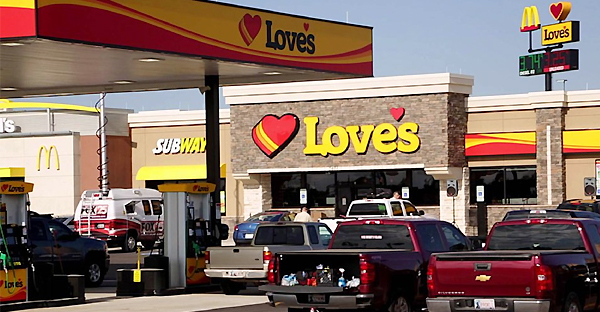
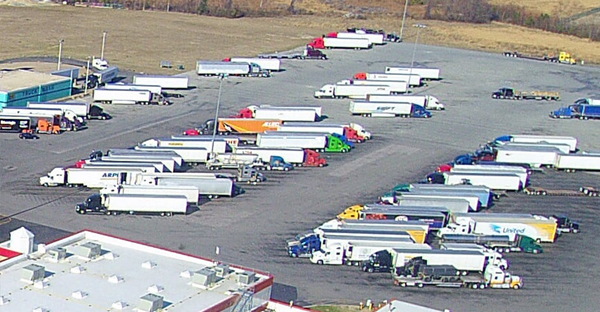
2. Maximize your stops: Plan to take care of everything you need at a truck stop when you are there the first time. Stopping to fuel, refill your coffee, and eat is better than stopping five times.
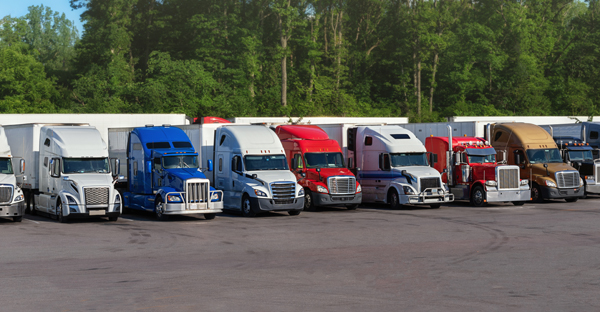
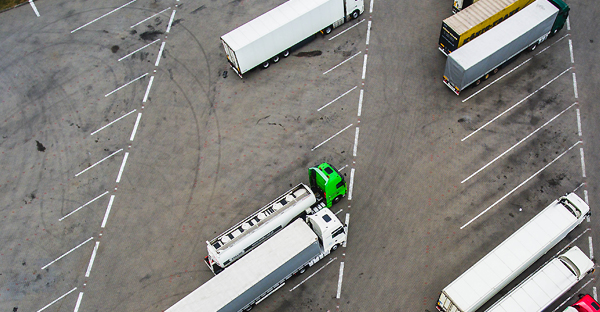
3. Avoid parking at the end of a row: Not only is there traffic crossing next to you but most people park on the end because they are tired and after a long day the end is the closest spot. Avoiding the end of a parking lot helps you avoid drivers who are parking when they are tired. Removing yourself from high traffic areas can help reduce risk.
4. Avoid a spot that will force you to back out when you leave: Choose a spot you can either pull through (the best option) or back into (second best option).
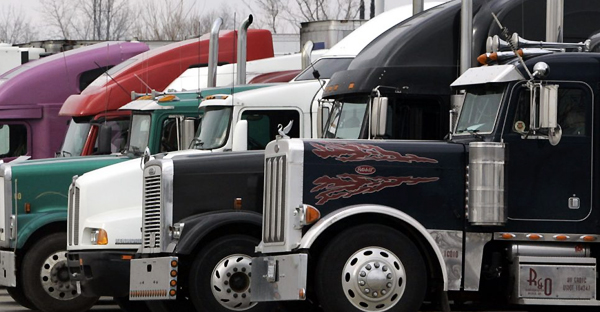
5. Park where there is space around you: The back of the lot will usually have more room than the front so let other drivers take the risk of all that traffic coming and going. No need to be a super Trucker when a safe and easy place is available. Think safe, not convenience.
6. Use your cameras: Don’t be complacent when parking. When your space is tight, utilize what you have to your advantage. Using your cameras will help you see tight spots on sides and at the rear. Take your time and you can also step down to survey the surrounding areas.


Trucker Spotlight - Jamar Holland <em>The Trucker Spotlight series explores the lives of truckers and their journey to make a difference in their industry. We interview different truck drivers to understand some life lessons that make them who they are today. We also learn more about their motivations, and the problems that they encounter on the job. We also tackle how Trucker Path's solutions helped them with what they do. The information that they provide helps inform other people who are looking to delve into the trucking world.</em>
<h2></h2>
[img src="https://truckerpath.com/uploads/2020/08/jh2.jpeg" alt=""]
<h2></h2>
Today we are putting the spotlight on Jamar, who's been driving for 4 1/2 years. He's a husband and a father who loves every minute of his trucking life. Let's get to know more about his life on the road.
<h2></h2>
<h3></h3>
<h3><strong>What made you decide to be a trucker?</strong></h3>
I decided to become a trucker honestly because everything else in my life had failed up until that point. I was tired of working dead end warehouse jobs and was really ready for a new career.
<h2></h2>
<h3><strong>In the years that you have been driving, what are the significant changes that you've
noticed in the trucking industry?</strong></h3>
The most significant change for my short career has definitely been ELDs. I had a short experience with paper logs but it became a challenge when we shifted to their electronic counterparts.
<h2></h2>
[img src="https://truckerpath.com/uploads/2020/08/jh3.jpeg" alt=""]
<h2></h2>
<h3><strong>What made you decide to put up your Youtube channel?</strong></h3>
Honestly, I never imagined my Youtube channel growing into what it is today, it actually just started as a way to vent-out and express myself. Somehow it became therapeutic to me and surprisingly to others as well. As it grew, I continued to take pride in being a voice for others like myself and giving motivation that truly anyone can be successful in life.
<h2></h2>
<h3><strong>Any times when you get lonely while driving? How do you deal with it?</strong></h3>
Absolutely, but thank God for technology. I recently started referring to myself as "FaceTime Daddy" and even though it's done jokingly, FaceTime and other similar forms of communication are pivotal for me and my family to remain sane and whole while I'm out here working to secure our future.
<h2></h2>
[img src="https://truckerpath.com/uploads/2020/08/jh4.jpeg" alt=""]
<h2></h2>
<h3><strong>As a trucker, what are the current struggles in this COVID19 pandemic?</strong></h3>
I think just the uncertainty of what will happen next, hoping that it doesn't effect my income so drastically like so many of my friends and family.
<h2></h2>
<h3><strong>What are your usual routes? Favorite scenic truck route?</strong></h3>
I usually stay on I40 and I5 in California, however my favorite scenery would definitely be Oregon just perfectly created in my opinion.
<h2></h2>
<h3><strong>What was your weirdest or most unusual haul?</strong></h3>
I picked up a load of hay in the middle of a Nevada desert that was literally 30 miles off the map.
<h2></h2>
<h3><strong>How often do you use rest stops / truck stops? What are the things that you look for in a truck stop? Favorite truck stop meal?</strong></h3>
I use both very often, first thing I look at is always the parking lot size and parking availability. Lucky for me, the Trucker Paths app is normally very accurate. As far as inside, I always look at reviews of the showers. There's nothing more disturbing than a poorly kept bathroom. Favorite truck stop meal is always a mom and pop diner with great breakfast!
<h2></h2>
<h3><strong>What are the common troubles or problems you encounter while trucking?</strong></h3>
Common troubles for me are rude and unsafe drivers. My biggest fear is that even if I can control and safely operate my truck, you never know when someone around you will do something that will not only jeopardize their life but yours as well.
<h2></h2>
<h3><strong>What are your pet peeves while driving/trucking?</strong></h3>
Biggest pet peeves are vehicles who enter the highway too slow, its literally called the acceleration lane.
<h2></h2>
[img src="https://truckerpath.com/uploads/2020/08/jh5.jpeg" alt=""]
<h2></h2>
<h3><strong>How did Trucker Path help you in your day to day trucking?</strong></h3>
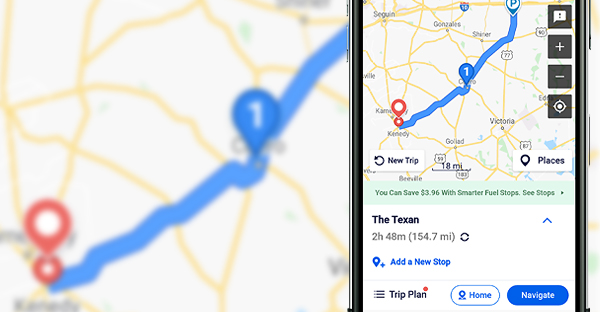
The fact that <a href="http://www.truckerpath.com">Trucker Path</a> can tell me how far each truck stop is from my exact location, that allows me to be very productive and productivity equals more money.
<h2></h2>
<h3><strong>What are some tips that you would like to share for aspiring truckers?</strong></h3>
Be confident when you're out here on the road and most importantly don't rush. The money will come and so will all your goals just keep pushing one day at a time. Like I always say on my channel, Stay safe, Stay positive and Stay productive.
<h2></h2>
<h3><strong>Where can people watch your videos on Youtube?</strong></h3>
They can view my videos on my <a href="https://www.youtube.com/user/Tre7DJHouse/featured">Youtube Channel, ATruckerNamedJay.</a>
<h2></h2>
<iframe width="560" height="315" src="https://www.youtube.com/embed/Y95yUN8oyfg" frameborder="0" allow="accelerometer; autoplay; encrypted-media; gyroscope; picture-in-picture" allowfullscreen></iframe>
<h2></h2>
Hope you guys enjoy!
<h2></h2>
<h2></h2>
<h4>By Aldous Aldwin</h4>
<h3></h3>
<h3></h3>
Start a Trucking Company With One Truck [h2]Start a Trucking Company With One Truck [/h2]
[p]Yes, it's possible to start a trucking company with one truck! Learn the steps to success here. [/p]
[p]The <a href="https://truckerpath.com/blog/trucking-industry-trends/">Trucking industry trends</a> and experts expect freight revenue to grow by 75 percent over the next nine years. [/p]
[p] With the trucking industry eclipsing over $726.4 billion in revenue for 2015, starting a trucking company now can be extremely lucrative. The trucking industry serves as a pillar in keeping things going and as long as people have demand for products, moving freight will be necessary for years to come.[/p]
[p]Don't be intimidated by the larger trucking companies with thousands of truck drivers and investors to provide capital. 90 percent of trucking companies are small fleets of six trucks or less so there's space in the industry for you to start a trucking company with one truck.[/p]
[h2] 1. Apply for Trucking Authority - Trucking Company Forms[/h2]
[p]Paperwork, documentation, and forms. They're tedious and might seem redundant but are necessary for you to get your trucking company started and earn <a href="https://truckerpath.com/blog/trucking-authority/">trucking authority</a>.[/p]
[p]If you haven't already been assigned a US DOT number, you will need to register for a DOT number form before you can apply to obtain trucking authority. Keep in mind the old [a href="https://www.fmcsa.dot.gov/registration/form-mcs-150-and-instructions-motor-carrier-identification-report"]MCS-150 form[/a] is now only for updating existing US DOT number and not for obtaining a US DOT number.[/p]
[p]To get a US DOT number you will need to use the new [a href="https://portal.fmcsa.dot.gov/UrsRegistrationWizard/"]Unified Registration System[/a]. The processing time can take 20-25 business days according to the FMCSA.[/p]
[p]If you already have a US DOT number and wish to apply for operating authority you can do so by [a href="http://li-public.fmcsa.dot.gov/LIVIEW/PKG_REGISTRATION.prc_option"]completing this registration form[/a] and paying the associated $300 fee.[/p]
[h2] 2. Choosing a Process Agent[/h2]
[p]You will need to choose a process agent who can represent you in regards to court papers. You will need to have a process agent for each state your trucking company operates in. They are used if there ever is an issue where court papers are to be served to your trucking company in a state other than the state your company is registered in.[/p]
[p]The FMCSA has a [a href="https://www.fmcsa.dot.gov/registration/process-agents"]list of process agents to choose from here[/a]. The process agent is responsible for completing [a href="https://www.fmcsa.dot.gov/sites/fmcsa.dot.gov/files/docs/registration/1996/boc-3-1-18-2017.pdf"]Form BOC-3[/a] on behalf of your trucking company.[/p]
[h2]3. Truck Insurance[/h2]
[p]Once you've established your trucking company you will need to make sure that it's properly insured. Liability insurance is required for trucking companies to cover potential damages or injuries caused by operating a commercial vehicle.[/p]
[p]Shop around and get several quotes before making a decision on which insurance provider is best for your trucking company. [a href="https://www.fmcsa.dot.gov/registration/insurance-requirements"]Here is a detailed overview of the FMCSA insurance requirements[/a] to help get you started.[/p]
[h2]4. Buying or Leasing a Truck[/h2]
[p]When starting your trucking company you can buy or lease trucks depending on what suits your needs best. If you have the working capital upfront to cover the cost and want to operate a small fleet with a few trucks, buying several trucks at once from a dealer might result in a discounted price per vehicle.[/p]
[p]You can also look into leasing trucks which often times keeps the monthly costs down and can even have a lease-to-own option available. However, there are usually restrictions that apply to leasing that vary by dealer. You will want to take the time to search and compare dealer options and offers before choosing.[/p]
[p]Lastly, there is also the option to purchase used trucks which can help save you upfront but can be costly down the line. You may find a used truck that is a few years old with over 400,000 miles on it for $40,000 to $50,000 less than a new one.[/p]
[p]It might be a great deal but remember, on average, truck repairs cost an estimated $15,000 annually according to the ATRI and with used trucks, that number can be even more.
[/p]
[h2]5. Choosing the Right Truck and Trailer Equipment [/h2]
[p]
Choosing the correct equipment to haul <a href="https://truckerpath.com/blog/types-of-truck-freight/">truck freight</a> can have a tremendous impact on your trucking companies earning potential. Although freight rates fluctuate week-to-week, typically flatbed truck loads pay the highest rate on average.
[/p]
[p]
That is not to say that a reefer, van or step deck load won't ever pay a better rate. Rather it's just an overall average to consider before choosing the equipment type for your truck. Keep in mind that location also plays a major factor in determining freight rates.
[/p]
[p]<strong>Looking ahead</strong>: when you're trucking company is set up, you can find truck freight to haul on free load boards like <strong>Truckloads</strong>. Customize your truck load searches by <a href="https://truckerpath.com/blog/what-is-deadhead/">deadhead</a> location and the trailer equipment type for you. [/p]
[button-green href="https://truckloads.truckerpath.com/?utm_source=blog&utm_medium=startonetruckcompany"]Find Freight Today[/button-green]
[video id="snyBYpnuhWw"]
[h2] 6. International Registration Plan (IRP)[/h2]
[p]
By registering your vehicle through the IRP in your home state, you will be allowed to haul interstate loads as well as freight through Canada without having to worry about additional registrations. You will be provided an apportioned license plate and cab-cards now display all jurisdictions that you cover.
[/p]
[p]
The IRP registration fee for your apportioned plate will vary depending on state and vehicle weight, but typically the price ranges from $1,500 - $2,000. [a href="https://www.fhwa.dot.gov/about/webstate.cfm"]Use this list to determine what the cost will be for your state.[/a]
[/p]
Industry Update - June 2, 2020 <h2></h2>
<h3></h3>
<a href="https://truckerpath.com/uploads/2020/06/b21.jpg"><img src="https://truckerpath.com/uploads/2020/06/b21-300x156.jpg" alt="" width="300" height="156" class="alignleft size-medium wp-image-4991" /></a>
<h3><strong>DOT to Distribute 2.1 Million Masks to Truckers</strong></h3>
The U.S. Department of Transportation will distribute around 2.1 million face masks to truck drivers. This is part of a larger initiative to distribute masks to transportation workers across the country.
“Transportation workers are on the frontlines of keeping our transportation systems operational during this public health emergency and their wellbeing and safety is paramount,” said Transportation Secretary Elaine Chao.
DOT announced that the masks will be sent out over the coming weeks through the U.S. Postal Service. The breakdown of masks by transportation sector is as follows:
<ul>
<li>Mass transit and passenger rail – 4.8 million</li>
<li>Aviation – 3.8 million</li>
<li>Maritime – 2.4 million</li>
<li>Freight rail – 2.2 million</li>
<li>Highway and motor carrier – 2.1 million</li>
<li>Pipeline systems – 258,000</li>
</ul>
For detailed distribution locations and current dates of distribution, please visit: <a href="http://www.fmcsa.dot.gov/masks">www.fmcsa.dot.gov/masks</a>
<h2></h2>
<h2></h2>
<a href="https://truckerpath.com/uploads/2020/06/b19.jpeg"><img src="https://truckerpath.com/uploads/2020/06/b19-300x156.jpeg" alt="" width="300" height="156" class="alignleft size-medium wp-image-4988" /></a>
<h3><strong>Volumes Now Up 10% vs Last Year</strong></h3>
<a href="https://www.freightwaves.com/news/volumes-fall-week-over-week-but-now-up-10-year-over-year">Outbound tender volumes are benefiting greatly from the reopening of the economy</a> and a release of pent-up consumer demand. Supply dynamics are taking longer to adjust and capacity remains loose. While rates are coming off a depressed base, spot rates have surged to $1.47 per mile and have increased in the vast majority of lanes.
<h2></h2>
Volumes should continue to be supported by most of the states reopening, continued plugging of the income gap by generous unemployment benefits and stimulus, auto plants reopening, and produce seasons kicking into gear.
<h2></h2>
<h2></h2>
<a href="https://truckerpath.com/uploads/2020/06/b20.jpeg"><img src="https://truckerpath.com/uploads/2020/06/b20-300x156.jpeg" alt="" width="300" height="156" class="alignleft size-medium wp-image-4989" /></a>
<h3><strong>Blinking Lights Cut Tanker-Truck-Crashes By Nearly 34%</strong></h3>
As part of their safety efforts, Groendyke Transport installed $150 blinking amber lights to the back of their tanker trucks. They reported a 33.7% drop in rear-end collisions over a 31-month period, according to company officials. In addition, there were zero rear-end collisions at railroad crossing during a test period of one year and seven months.
<h2></h2>
The Groendyke Transport fleet currently has 900 trailers with the lights after almost three years of testing and now has <a href="https://beta.regulations.gov/document/FMCSA-2018-0223-0036">permission from FMCSA</a> to use them.
<h2></h2>
The cost of the strobe and installation is about $150.
<h2></h2>
<h2></h2>
<h2></h2>
<h4>By Aldous Aldwin</h4>
<h3></h3>
<h3></h3>