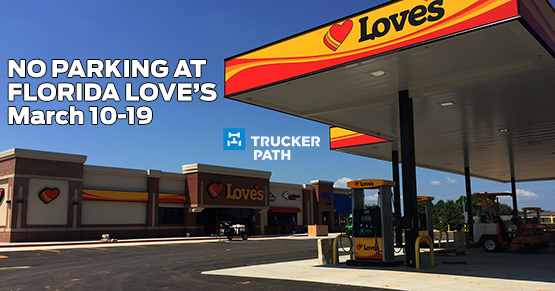
Love’s travel stop in Florida won’t allow truck parking during bike week.
The Love’s travel stop in Ormond Beach of I-95 will not allow trucks to park from March 10–19 due to the increased traffic resulting from Bike Week. In the past, local law enforcement officials say there have been up to three miles of backups on I-1 and 1-95 near the Love’s location because of the event. Trucks will still be allowed to fuel up at the location.
There are over 7,000 locations for parking in the Trucker Path app. Be sure to plan ahead to find locations with available truck parking nearby. Search for TA & Petro, Pilot & Flying J, independent truck stops and Walmarts that allow overnight truck parking.

“In the past when we attempted to impose 30-minute parking limits for trucks, it was difficult to enforce. The increased traffic volumes for truckers waiting to fuel – combined with the significant influx of cars, trucks and bikes during that week – caused traffic jams to the point that State Police had to close the exit. Love’s wants to provide the necessary fueling for our professional truck driver Customers, but to ensure that is still available, we need to keep the trucks moving in and out at that exit.”
Love’s Location: 1657 US Hwy 1, Ormond Beach, FL 32174.


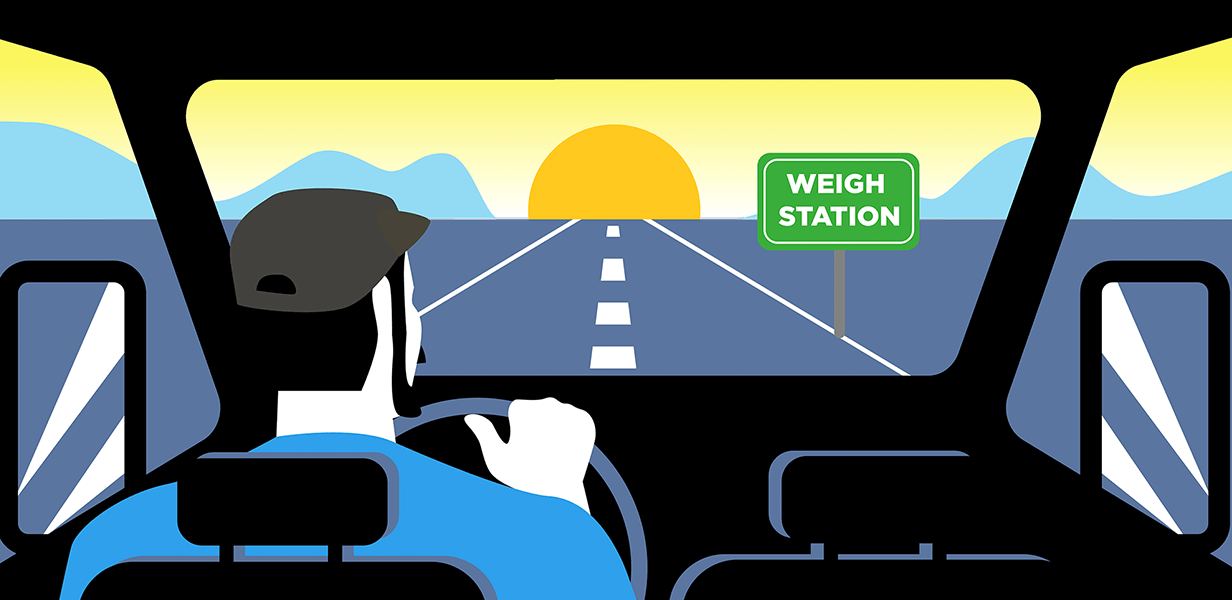
What is a Weigh Station?
[p]Drive on any major interstate and you will eventually come across a green sign saying “weigh station”. So what is a weigh station for anyhow?[/p]
[h2]What is a Weigh Station?[/h2]
[p]A weigh station is a designated location, typically located directly off of highways, where the Department of Transportation or state highway patrol inspects the weight of a vehicle. The reason why there are weigh stations is to ensure that the roads are not compromised by a potentially overweight vehicle. In America, the maximum weight that a truck with a full trailer can be on the road is 80,000 pounds (some exceptions). Additionally, a weigh station that is on the border of two states is called a port of entry.[/p]
[p][i]The Simpsons – Maximum Homerdrive[/i][/p]
[giphy]<iframe src="https://giphy.com/embed/3o6Mbt3gvvQdFlWg4E" width="480" height="269" frameBorder="0" class="giphy-embed" allowFullScreen></iframe>[/giphy]
[h2]Who Has to Stop at a Weigh Station?[/h2]
[p]Any commercial motor vehicle (CMV) that weighs over 10,000 pounds is required to stop at a weigh station unless the driver has a PrePass or other weigh station bypass service. [a href="https://app.appsflyer.com/com.sixdays.truckerpath?pid=Social Facebook"]Truck drivers can use Trucker Path[/a] to check ahead and see if a weigh station is open or closed in real-time. This can be extremely valuable to help truckers save valuable time.[/p]
[giphy]<iframe src="https://giphy.com/embed/xT5LMsfqY4WgipchIA" width="480" height="269" frameBorder="0" class="giphy-embed" allowFullScreen></iframe>[/giphy]
[h2]What Do Truckers Mean When They Say Chicken Coop?[/h2]
[p]With over [a href="https://truckerpath.com/blog/trucks-delivering-cargo-in-the-usa"]1.6 million heavy-duty truck drivers in America[/a] weigh stations can become extremely congested and can cost drivers precious time, not to mention waste fuel. Some truckers will refer to weigh stations as "chicken coops" because the large trucks are forced into a confined space prior to being weighed, like chickens in a coop.[/p]
[h2]What Happens at a Weigh Station?[/h2]
[p]When a truck driver sees a weigh station that says OPEN, he or she must exit the freeway and enter the scales to be weighed. The majority of weigh stations have a rolling scale where a truck will roll past a certain area that has a scale (could differ by state). Once a truck is weighed and verified to weigh under 80,000 pounds, the truck will be granted a green light to exit the weigh station and proceed back on its route.[/p]
[p]After a truck goes through the scales either the DOT or state inspection officer can flag the truck for an inspection.[/p]
[p]At a weigh station, trucks can be inspected for a variety of reasons. DOT officers or Federal Motor Carrier Safety Administration agents conduct a thorough equipment safety inspection to find issues with a truck including:[/p]
[ul]
[li]low or flat tires[/li]
[li]tire tread[/li]
[li]oil, fuel or anti-freeze leaks[/li]
[li]brake malfunctions[/li]
[li]broken springs[/li]
[li]securely mounted fuel tanks[/li]
[li]cracks in wheels and rims[/li]
[li]unlocked kingpin[/li]
[li]hose or tubing leak[/li]
[/ul]
[p]Any of these violations can lead to a truck being declared out-of-service (among a variety of others). If the FMCSA declares a truck as out-of-service, the truck shall be towed and not operated until repairs to the violations found during the inspection are completed. Truckers will also have to have repairmen sign Form MCS63 issued by the FMCSA to verify proper repairs were made.[/p]
[giphy]<iframe src="https://giphy.com/embed/3o6MbiPDaKvIei93KU" width="480" height="269" frameBorder="0" class="giphy-embed" allowFullScreen></iframe>[/giphy]
[h2]Log Book Inspection[/h2]
[p]A truckers' truck isn't the only thing that can be inspected. A truck drivers' log book can also be checked by an officer to ensure the driver is keeping a daily log of his or her record and isn't in violation of hours-of-service laws. DOT HOS regulations include:[/p]
[ul]
[li]Maximum 11 hours of driving during a 14-hour period[/li]
[li]No more than 60 hours total in seven consecutive days on duty[/li]
[li]No more than 70 hours total in eight consecutive days on duty[/li]
[li]Required 10 consecutive hours off after 11 hours of driving[/li]
[/ul]
[p]Changes are coming for log books. The FMCSA Electronic Logging Device mandate will begin in December. The ELD mandate requires truckers to use an ELD to keep a record of his or her log book to comply with HOS regulations. HOS fines can range from $150 to over $1,000 each.[/p]
[h2] Is There a Weigh Station Near Me? [/h2]
[p] Ever ask yourself, is there a weigh station near me? As a truck driver, it's important to know if there is a weigh station near you along your route. Using the <strong>Trucker Path</strong> app you can see where weigh stations are located nearby and see if they're open or closed. [/p]
[p] Want to save even more time? Plan ahead using the trip planning feature in the Trucker Path app to determine the locations of weigh stations along your route. Don't forget to update the status too! [/p]
[button-green href="
https://truckerpath.com/trucker-path-app/?utm_source=blog&utm_medium=whatsweighstation&utm_campaign=Aug14"]Try TruckerPath Today[/button-green]
[video id="NSSOwFRJaQw"]
Worst Traffic Bottlenecks in America [p] Which locations landed on American Transportation Research Institutes [a href="https://app.appsflyer.com/com.sixdays.truckerpath?pid=Social Facebook"]top 100 worst traffic bottlenecks in America[/a]?[/p]
[p]Bottlenecks, no not the Budweiser kind. Rather the worst traffic bottleneck that causes extreme delays can derail a truck drivers schedule. Let's take a look at the list of places where drivers are bound to be waiting in triaffic. [/p]
[h2]1. Atlanta Spaghetti Junction[/h2]
[p]Winner winner, spaghetti dinner! After analyzing over 600,000 heavy-duty trucks, the ATRI deemed the intersection of [b]Interstates 285 and 85 North in Atlanta[/b], known as the “Spaghetti Junction” is the most congested freight bottleneck in America.[/p]
[ol]
[li]Atlanta Spaghetti Junction[/li]
[li]I-95 at State Route 4 in Fort Lee, New Jersey[/li]
[li]I-290 at I-90/94 in Chicago, Illinois [/li]
[li]I-65 at I-64/71 in Louisville, Kentucky[/li]
[li]I-71 at I-75 in Cincinnati, Ohio[/li]
[li]SR 60 at SR 57 in Los Angeles, California[/li]
[li]SR 18 at SR 167 in Auburn, Washington[/li]
[li]I-45 at US 59 in Houston, Texas[/li]
[li]I-75 at I-285 North in Atlanta, Georgia[/li]
[li]I-5 at I-90 in Seattle, Washington[/li]
[/ol]
[giphy]<iframe src="https://giphy.com/embed/3o7qE3a5YpLpCdeq0U" width="480" height="269" frameBorder="0" class="giphy-embed" allowFullScreen></iframe>[/giphy]
[h2]Which State Has the Worst Bottlenecks?[/h2]
[p][b]Texas has the most bottleneck of any state[/b], with nine locations ranked among the top 50 worst. Washington has six locations in the top 50, California has five – primarily in the Los Angeles area, while Georgia has four.[/p]
[h2]Which City Has the Worst Bottlenecks?[/h2]
[p]Staying in the Lone Star state, the city with the worst bottleneck congestion is [b]Houston[/b]. Not only does Houston have three locations in the top 15, it has six in the top 40. Seattle is another city with major bottleneck traffic congestion with five locations on the top 100 list.[/p]
[h2]Difference Between Traffic Jam and Bottleneck[/h2]
[p]A bottleneck differs from a traffic jam because a bottleneck is caused by a road design or flaw in the timing of traffic lights. Bottleneck traffic can be limited if there is a proper redesign of the roadway, something that is extremely costly and time-consuming. The most common causes of bottlenecks are:[/p]
[ul]
[li]Traffic Interruption – the most common causation of bottleneck traffic that includes railway crossings, tolls, stop signs or traffic lights.[/li]
[li]Lane Reduction – a merge caused by the reduction in the number of lanes.[/li]
[li]Merging – specifically when two major highways intersect.[/li]
[/ul]
[p]American Trucking Association President Chris Spear sees the results of the ATRI study as an indication of infrastructure issues that the Trump Administration should address.[/p]
[quote]“With President Trump expected to press for significant long-term infrastructure spending, this ATRI analysis should be a key guide for deciding what projects are worthy of funding,” Spear said. “Ensuring the safe and efficient movement of goods should be a national priority and this report draws attention to the places where our highway network needs improvement in order to meet that goal.”[/quote]
[giphy]<iframe src="https://giphy.com/embed/2bgR8ybgyJU6Q" width="480" height="269" frameBorder="0" class="giphy-embed" allowFullScreen></iframe>[/giphy]
[button-white href="http://atri-online.org/wp-content/uploads/2017/01/2017-ATRI-Bottleneck-Brochure.pdf"]Full List[/button-white]