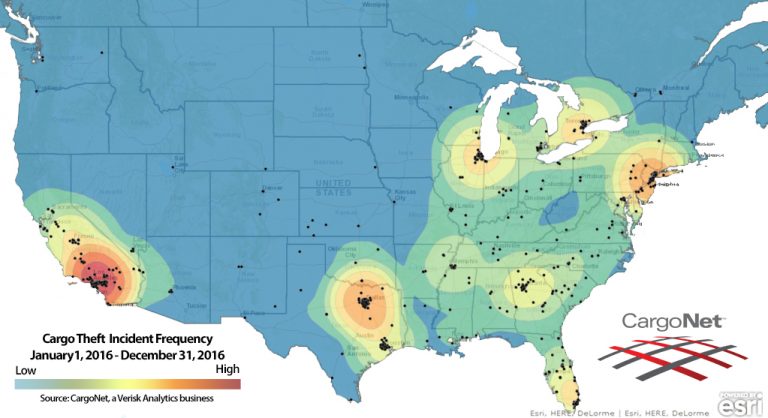
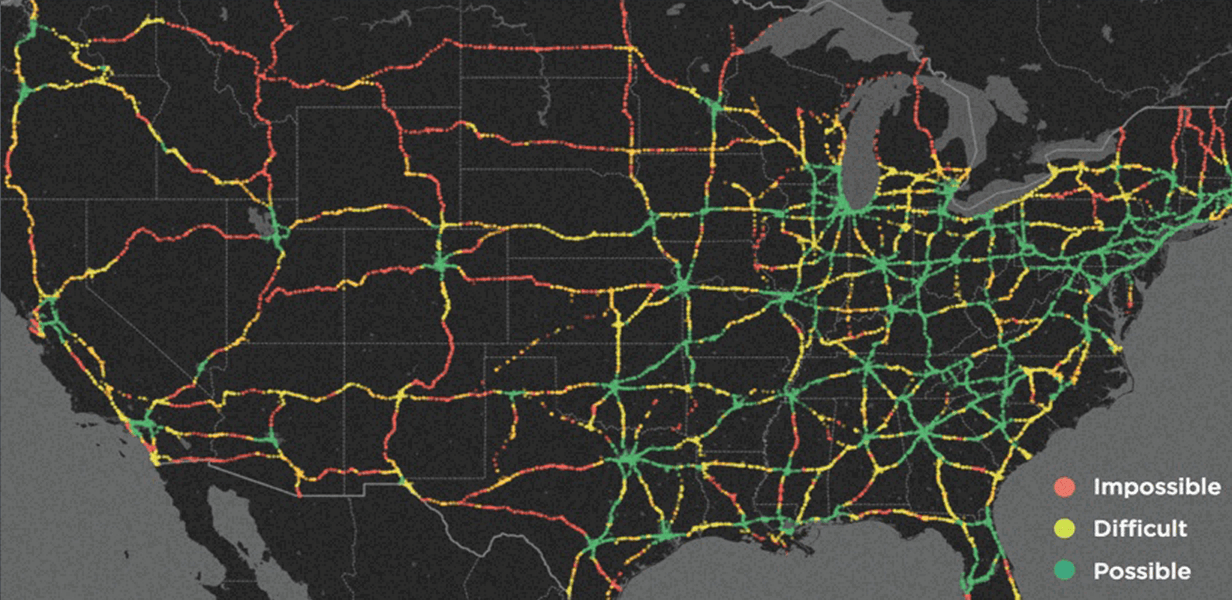
Cargo theft is a growing concern for the trucking industry with driver safety at the forefront. Here’s a closer look at the worst areas.
Being a truck driver is the most dangerous job in America and the threat of cargo theft from potentially armed thieves looking to steal truck cargo escalates the risks for truck drivers.
According to CargoNet, there were 836 occurrences of cargo theft resulting in an estimated $172.9 million in losses during 2016. Los Angeles County had 329 thefts reported from July 2013 – July 2016, the most of any other county in America. The worst state for cargo thefts was California, with 228 thefts, an increase of 36 percent from 2015. The most common day of the week for cargo thefts was Friday with 164 incidents. There was a 5.1 percent decrease in total cargo thefts in 2016 compared to 2015.

Best of all you can see how many truck parking spots a truck stop has and see if there are any available in real-time. Download our free app today in order to save yourself time and provide you with the peace of mind you deserve.
“Cargo theft continues to be a pervasive issue,” said Anthony Canale, general manager of CargoNet. “Our 2015 year-end report indicated 881 incidents of cargo theft took place across North America. That increased from 844 cargo thefts reported in 2014 and accounted for more than $175 million in goods. While thieves continue to get more tech-savvy with their approaches, there are measures that can be put in place to stop them, ranging from proactive deterrence tactics to extensive recovery assistance.”


New Year, New Trucks 2021
[p]The trucking industry has had to deal with several challenges in the past few years, with more yet to come. The ever-changing world has ushered in a new era urging the industry to change with it. We have arrived at a point in time, where the environment is better cared for, and driver safety is held supreme. As a result, traditional semi-truck manufacturers have had to adapt and conform to modern safety and emission standards. The new threat from all-electric trucks is another drive for old truck manufacturers to change their ways or risk losing to the competition. We are nearing the era of sustainable, greener trucks that are environmentally friendly and easy to drive.
[/p]
[p]So what do we have in store for 2021? Let's take a look at the much-awaited upcoming trucks from the industry-leading marques.
[/p]
<h2></h2>
[p][b]Kenworth [/b][/p]
[p]Kenworth is one of the oldest truck manufacturers in America with a rich history. They have plenty to offer when it comes to heavy-duty class 7 and class 8 trucks. The Kenworth T680, the Kenworth W990, and the Kenworth T880 are three notable mentions that deserve a place on our list. The three trucks are due to come out in 2021 with a fresh approach towards safety, efficiency, and performance. [/p]
[img src="https://truckerpath.com/uploads/2021/01/202101-BLOG-New-Year-New-Trucks-2021-Kenworth.jpg" alt=""]
[p]The giant machines are safer than ever, with a host of driver-assist features to make driving hassle-free. The W990 and the T880 can sport the Wabco OnGuardACTIVE safety system that enhances your abilities as a driver. [/p]
[p]What’s more, the new T680 gets Level 2 autonomy with Bendix Wingman Fusion, which is a step into the future for the traditional marque. Kenworth has also partnered with the Meritor for the T680e, an electric version of the sturdy T680 that would work wonderfully on short routes. [/p]
<h2></h2>
[p][b]Peterbilt [/b][/p]
[p]The Peterbilt 579 comes new and improved for 2021 with even better comfort and safety options. The 579 truck has been a popular choice in the past years, and more customers are likely to turn towards the new UltraLoft Sleeper model. The fresh model 579 comes with the Bendix Wingman Fusion system as standard.[/p]
[img src="https://truckerpath.com/uploads/2021/01/202101-BLOG-New-Year-New-Trucks-2021-Peterbilt.jpg" alt=""]
[p]The 579 truck has top of the line aerodynamics that reduce drag, improve efficiency, and result in overall better performance on the highway. Not to mention the mighty engine that roars under the hood producing inhumane levels of torque. [/p]
[p]The Peterbilt 389 is another popular model that makes its way into 2021 with extra features to go with its traditional styling. It comes equipped with Peterbilt’s SmartNav technology and the SmartLINQ diagnostics system that allows over the air updates and lets you diagnose engine issues while sitting in the cabin. The 389 is a step in the future with the same traditional looks. [/p]
<h2></h2>
[p][b]Mack [/b][/p]
[p]Mack trucks have been around for more than a century and they have proven to be the best of the rest. The Mack Anthem is a testament to Mack's unwavering commitment to making up-class trucks. The Anthem comes with a dominant design, a potent engine, and a comfortable interior making it the perfect all-around truck for highway driving. [/p]
[img src="https://truckerpath.com/uploads/2021/01/202101-BLOG-New-Year-New-Trucks-2021-Mack.jpg" alt=""]
[p]The 2021 machine gets Command Steer that reduces the driver's effort by over 30% allowing you to maneuver with masterful precision anytime every time. However, if you are a bit of an old-timer then the Mack Pinnacle is the truck for you. This traditionally designed big-rig carries on with the design philosophy of an old truck, but it has the safety and technology of a modern one. The Pinnacle has a low center of gravity for better road grip, a forward axle position for heavier payloads, and a sturdy chassis to handle extremely heavy freight. All in all, a great truck for both off-road and on-road applications. [/p]
<h2></h2>
[p][b]Freightliner [/b][/p]
[p]The Freightliner Cascadia takes the limelight in the Freightliner line-up as this new truck comes with a host of modern technological upgrades that old truckers would only dream of in their time. The Daimler Detroit Assurance Suite 5.0 comes equipped in the Cascadia providing Level 2 autonomy and safety. On the other hand, the Detroit powertrain ensures no payload is heavy enough for Cascadia. [/p]
[img src="https://truckerpath.com/uploads/2021/01/202101-BLOG-New-Year-New-Trucks-2021-Freightliner.jpg" alt=""]
[p]If you are looking to shift to a greener option within the Freightliner line-up, you can consider the eCascadia, an electric version of the brilliant Cascadia. The e-version gets all the tech and safety features and the comfort options found in the Cascadia. The largest difference comes in terms of performance as the eCascadia gets a 475 kWh battery to power the truck for 250 miles. The 0 to 80% charge takes 90 minutes, which is remarkable considering the size of the battery. [/p]
<h2></h2>
[p][b]Conclusion[/b][/p]
[p]When it comes to buying a semi-truck in America there are many options to consider. You can go for the more traditional looking variants or step into modern territory with the futuristic-looking big-rigs. If you go even further, there is the all-electric truck market that hasn't been tapped to its full potential. The Tesla Semi is one truck you can consider as it is planned for a 2021 release. No matter the case, with <a href="https://www.epa.gov/transportation-air-pollution-and-climate-change/carbon-pollution-transportation">emissions reaching alarming levels</a>, it is time for the semi-truck manufacturing industry to move into new territories. [/p]
<h2></h2>
<h2></h2>
[p][b]By Aldous Aldwin[/b][/p]
ELD Mandate Exemptions [p]Get clarification on electronic logging devices and ELD mandate exemptions set to take effect in December 2017. [/p]
[h2]ELD Mandate Exemptions[/h2]
[p]As of December 18, 2017, most drivers that currently use paper logs will have to switch over to an electronic logging device. The choices will be an automatic onboard recording device (AOBRD) meeting the current requirements in §395.15, installed before December 18, 2017, or a device meeting the electronic logging device (ELD) standards found in Subpart B to Part 395 and the associated appendix.[/p]
[p]There are <strong>five ELD Mandate exemptions</strong> including:[/p]
[ul]
[li]Drivers that only had to fill out a log eight or fewer days out of the last 30 days. This would include “short-haul” drivers that normally operate under the 100 and 150 air-mile exceptions and intermittent drivers.[/li]
[li]Drivers operating a vehicle older than the model year 2000. This also applies to the model year 2000 and newer vehicles that do not have the original engine in them, if the engine serial number indicates that the engine is older than the model year 2000. [/li]
[li]Drivers operating a vehicle that is part of a driveaway/towaway shipment. [/li]
[li]Drivers driving or towing a recreational vehicle that is part of a driveaway/towaway shipment.[/li]
[li]Drivers who are driving a truck that was rented for eight days or less. [/li]
[/ul]
[p]How are officers on the road going to verify that a driver claiming one of the exemptions is actually entitled to it? It is easier than you might think. [/p]
[h2]ELD Exemptions and Short-Haul Drivers[/h2]
[p]During a roadside inspection, the officer can contact the carrier for the time records related to a driver he/she is inspecting. The officer can then verify that the driver is complying with the terms of the 100 or 150 air-mile exemptions. This simply involves the officer verifying that there were time records and they showed the driver staying under the limits attached to the exemption. [/p]
[p]If the records show the driver as operating under the 100 or 150 air-mile exception often enough, there would be no violation for the driver not using an ELD.[/p]
[p]As far as intermittent drivers, the officer will inquire as to how many days the driver has worked out of the last 30. If it ends up to be 8 or fewer out of any 30-day period, there is no violation.[/p]
[h2]ELD Exemptions on Older Vehicles[/h2]
[p]To verify that the driver can use paper logs due to the age of the vehicle, the officer will simply check the vehicle identification number (VIN). If the VIN indicates that the vehicle is the model year 1999 or older vehicle, there will be no violation for the driver using a paper log rather than an electronic log.[/p]
[p]How is this determined? [/p]
[p]The model year is coded in the vehicle’s VIN at the 10th position. Presently, 2000 and newer vehicles have Y, 1 to 9, or A to H in the 10th position (i, o, u, and z are not used in VINs by the way). If the 10th digit is anything other than those listed, the vehicle is manufactured before 2000.[/p]
[p]In the case of the model year, 2000 or newer vehicle that has been retrofitted with the model year 1999 or older engine, to determine if the engine is manufactured before the year 2000, the officer will ask to see the engine serial number. Using the serial number and available software, the officer can quickly validate the engine model year.[/p]
[h2]Driveaway/Towaway ELD Exemptions[/h2]
[p]To verify that the driver is allowed to use the driveaway/towaway exception to use a paper log rather than an electronic log after December 18, 2017, all the officer or auditor needs to do is ask for the shipment paperwork. The shipment paperwork will then be used to verify that the vehicle the driver is operating is part of the shipment. If so, then there would be no violation for the driver using a paper log rather than an electronic logging device.[/p]
[h2]Rented Trucks[/h2]
[p]To verify that a driver is allowed to use the rented truck exemption, the driver must be able to present the rental agreement showing that the vehicle is being rented for 8 days or less. The driver must use paper logs and have records for the previous seven days. Printouts from an ELD system are acceptable. The exemption does not cover “leased” vehicles or vehicles rented for more than 8 days. Multiple back-to-back rental agreements will result in the carrier being cited for not using ELDs.[/p]
[h2]Still Confused about ELD Mandate Exemptions?[/h2]
[p]If you’re still confused about Exemptions to the mandate or wondering if you need to comply with the ELD mandate, contact J.J. Keller for a free ELD Exemption Assessment. Their ELD specialist will guide you through 21 questions created by their hours of service subject matter experts to help you determine if you are exempt from using ELDs. Call the ELD Exemption hotline at 888-531-8899 or <strong>request an assessment <a href="https://www.jjkeller.com/webapp/wcs/stores/servlet/infoform_10151_-1_10551_52145?cm_mmc=Misc-_-ELDExemptionAssessment-_-eldexempt-_-null">here</strong></a>.[/p]
[p]<strong>J. J. Keller & Associates, Inc.</strong>[/p]
[p]Since its beginning as a one-man consulting firm in 1953, J. J. Keller & Associates, Inc. has grown to become the most respected name in safety and regulatory compliance. Now over 1,400 associates strong, J. J. Keller serves over 600,000 customers — including over 90% of the Fortune 1000® companies. The company’s subject-matter expertise spans nearly 1,500 topics, and its diverse solutions include ELogs and mobile technology; training via online courses, streaming video or DVD; online management tools; managed services; consulting services; online and print publications; forms and supplies.[/p]
<strong>[p]About the Author:[/p]</strong>
[p]Tom Bray has been with J. J. Keller & Associates, Inc. for 11 years. However, as he does not get enough excitement working at J. J. Keller and chasing after six kids and nine grandkids, he also chooses to work nights and weekends as a firefighter/EMT.[/p]